

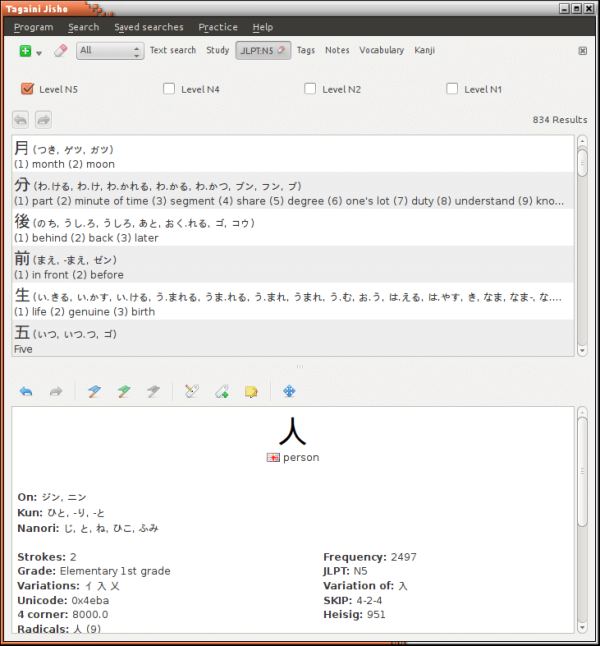
Tagaini Jisho is an open source Japanese vocabulary and kanji dictionary that aims at presenting results in a way that makes it easy to create connections in your mind and remember them.
To allow this, it keeps track of all the entries you already know and allows you to tag and add notes to them. It also features kanji drawing animations for more than 6000 kanjis, flashcard-like training, production of paper material for studying, and extended search options for vocabulary and kanjis including part-of-speech and JLPT levels.
Tagaini Jisho makes heavy use of the embedded SQLite database.
Key Features
- Complete Japanese vocabulary and kanji Dictionaries, with more than 140,000 vocabulary and 12,000 kanji entries.
- Kanji dictionary based on kanjidic2 and KanjiVG.
- Powerful search engine with many search parameters: JLPT level, part-of-speech, full wild-card support etc.
- Entries can be marked for study and have a score that evolves as you correctly recognize them.
- Training mode for studied entries, where lowest score entries are more likely to be trained.
- Print feature with connections between studied kanji and vocabulary, in a format that allows both studying and flash-carding (thumb-hideable Japanese part).
- Radical and component-based kanji look-up, including an input method that lets you find almost any kanji, as long as you can recognise some of its components.
- JLPT classifications of vocabulary and kanji.
- A study list that keeps track of all the vocabulary and kanji entries you wish to study.
- Sets let you easily remember any search, allowing you to quickly access queries like “What were the JLPT-2 kanji that I added to my study list this week?”
- Notes and tags can be applied to entries, allowing you to group entries in a way that makes sense to you.
- Hierarchical and ordered lists provide an easy way to classify vocabulary and kanji found in textbooks or to organise them arbitrarily.
- Stroke order animations for more than 6000 kanji.
- Kana panel that allows the study of hiragana and katakana.
- Transparent connection of related entries, including transitive / intransitive verb references, Homophones and Homographs. Tagaini maximises the logical connections between elements of the Japanese language in order to facilitate their memorisation.
- Flash cards for vocabulary and kanji entries that remember which entries you are having difficulty memorising so that Tagaini may display them more frequently.
- Production of printed material, including a handy fold-able booklet to study anywhere.
Website: www.tagaini.net
Support: User Manual
Developer: Alexandre Courbots
License: GNU General Public License v3.0
Tagaini Jisho is written in C++. Learn C++ with our recommended free books and free tutorials.
Related Software
| Foreign Language Tools | |
|---|---|
| Tagaini Jisho | Japanese vocabulary and kanji dictionary |
| Anki | Extensible flashcard learning program |
| Lute | Learning Using Texts |
| LibreLingo | A modern language-learning platform |
| Kiten | Japanese reference and study tool |
| Step into Chinese | Language-mining tool to help English speakers understand Chinese |
| Parley | Vocabulary trainer for KDE |
| LinguaCafe | Helps language learners acquire vocabulary by reading |
| Artikulate | Pronunciation trainer - The KDE Education Project |
| Jargon Informatique | Front-end for the French computing dictionary Jargon Informatique |
| Verbiste | French and Italian conjugator |
| VocabSieve | Anki companion for language learning |
| Glossaico | Language learning application based on LibreLingo |
| OpenTeacher | Learn words in a foreign language |
| Kana | Learn Japanese characters |
| JapaChar | Learn Japanese characters |
| Perroquet | Train your oral skills in foreign languages |
Read our verdict in the software roundup.
 Explore our comprehensive directory of recommended free and open source software. Our carefully curated collection spans every major software category. Explore our comprehensive directory of recommended free and open source software. Our carefully curated collection spans every major software category.This directory is part of our ongoing series of informative articles for Linux enthusiasts. It features hundreds of detailed reviews, along with open source alternatives to proprietary solutions from major corporations such as Google, Microsoft, Apple, Adobe, IBM, Cisco, Oracle, and Autodesk. You’ll also find interesting projects to try, hardware coverage, free programming books and tutorials, and much more. Discovered a useful open source Linux program that we haven’t covered yet? Let us know by completing this form. |
Please read our Comment Policy before commenting.