
System Options
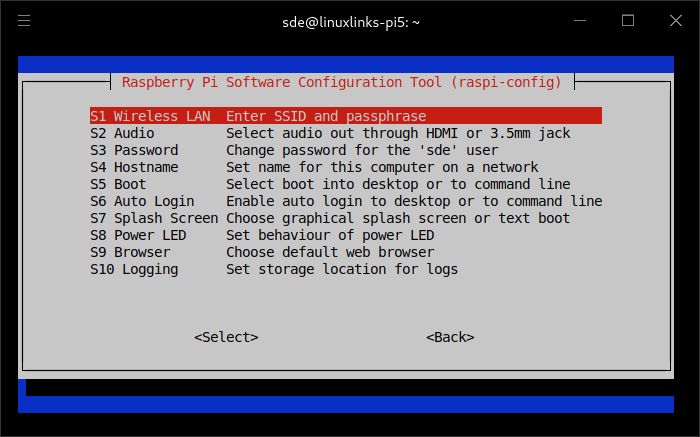
- S1 Wireless LAN – configure the Wi-Fi SSD and passphrase. SSID stands for Service Set Identifier and is the name of a wireless network. It’s just as easy configuring this in the Network Settings GUI.
- S2 Audio – specify the audio output destination.
- S3 Password – change the password for the current user. It’s also possible to change the password with the
passwdprogram. - S4 Hostname – set the visible hostname for the Raspberry Pi.
- S5 Boot – there’s the option to boot to a text console, or the desktop GUI. If you’re Pi doesn’t have a lot of physical RAM, you may prefer setting the default to login to the console. If so, you can always then start the desktop GUI with the
startxcommand. - S6 Auto Login – here we have the option to automatically log in to the console, and the option to automatically log in to the desktop.
- S7 Splash Screen – enable or disable the splash screen at boot.
- S8 Power LED – this option does not apply to the Raspberry Pi 5, as the LED behaviour cannot be changed.
- S9 Browser – change the default web browser. Choose between Chromium and Firefox. A nice touch is that whichever one is set is started from the web browser icon in the taskbar.
- S10 Logging – Choose between default, volatile, persistent, auto, or none.
Next page: Page 3 – Display Options
Pages in this article:
Page 1 – Introduction
Page 2 – System Options
Page 3 – Display Options
Page 4 – Interface Options
Page 5 – Performance Options
Page 6 – Localisation Options
Page 7 – Advanced Options
All articles in this series:
| Raspberry Pi 5 Series | |
|---|---|
Hardware | |
| iRasptek Starter Kit | All the kit you need to get started with the Pi 5 |
| Pironman 5 Case Review | Transform the Pi 5 into a beautiful desktop mini PC |
| Passive Cooling the Pi 5 | Passively cool your Pi 5 the right way. Silent yet cool |
| Benchmarking | Benchmarking the Pi 5 against an Intel N100 mini PC |
| Overclocking | Let's increase the clock speed of the BCM2712 SoC |
| Power Consumption | Compare the power consumption of the Pi 5 with Intel Mini PCs |
| 2.5Gbps Networking | Improving the wired performance of the Pi 5 |
| WiFi | Improve WiFi performance of the Pi 5 |
| Desktop PC | Is the Pi 5 good value compared to an Intel N100 Mini PC? |
Configuration | |
| raspi-config | Useful text-based tool to configure the Pi 5 |
| PiGro | GUI tool that streamlines the process of managing the Pi 5 |
| Increase Swap Memory Size | Increase the swap size from 512MB to 2GB |
| ZRAM swapdrive | Simple script to use a ZRAM swapdrive instead of a swapfile |
Software | |
| Installing Software | Different ways to install software on the Pi 5 |
| df snap pollution | Replace df with dysk |
| Ollama GUI | Running Large Language Models on the Pi 5 |
| Music Players | GUI and TUI music players explored |
| Internet Radio | Exploring the best options for both GUI and TUI software |
| Many software articles are planned. Stay tuned! | |