
NeuPy is an open source Python library for Artificial Neural Networks and Deep Learning.
NeuPy supports many different types of Neural Networks from a simple perceptron to deep learning models.
NeuPy is based on the Theano framework. This allows users to easily train neural networks with constructible architectures on GPU.
Key Features
- Deep Learning.
- Reinforcement Learning (RL).
- Convolutional Neural Networks (CNN).
- Recurrent Neural Networks (RNN).
- Restricted Boltzmann Machine (RBM).
- Multilayer Perceptron (MLP).
- Networks based on the Radial Basis Functions (RBFN).
- Associative and Autoasociative Memory.
- Ensemble Networks.
- Competitive Networks.
- Basic Linear Networks.
- Regularization Algorithms.
- Step Update Algorithms.
- Supports lots of different training algorithms based on the backpropagation:
- Classic Gradient Descent – an optimization algorithm often used for finding the weights or coefficients of machine learning algorithms, such as artificial neural networks and logistic regression.
- Mini-batch Gradient Descent – a variation of the gradient descent algorithm that splits the training dataset into small batches that are used to calculate model error and update model coefficients.
- Conjugate Gradient – solve a symmetric positive-definite system of linear equations of dimension N in exactly N steps.
- quasi-Newton – find zeroes or local maxima and minima of functions, as an alternative to Newton’s method.
- Levenberg-Marquardt – solves generic curve-fitting problems.
- Hessian – a matrix of all possible calculus second derivatives for a function.
- Hessian diagonal.
- Momentum – a method that helps accelerate SGD in the relevant direction and dampens oscillations.
- RPROP – resilient backpropagation, a learning heuristic for supervised learning in feedforward artificial neural networks. It’s widely regarded as one of the best performing first-order learning methods for neural networks with arbitrary topology.
- iRPROP+ – a modification of RPROP with a weight-backtracking scheme.
- Quickprop – an implementation of the error backpropagation algorithm.
- Adadelta – an extension of Adagrad that seeks to reduce its aggressive, monotonically decreasing learning rate.
- Adagrad – an algorithm for gradient-based optimization. It’s useful for dealing with sparse data.
- RMSProp – an adaptive learning rate method proposed by Geoff Hinton.
- Adam – Adaptive Moment Estimation, an algorithm for first-order gradient-based optimization of stochastic objective functions, based on adaptive estimates of lower-order moments.
- AdaMax – a special case of Adam.
Website: neupy.com
Support: Documentation, Cheat Sheet, GitHub code repository
Developer: Yurii Shevchuk
License: MIT License
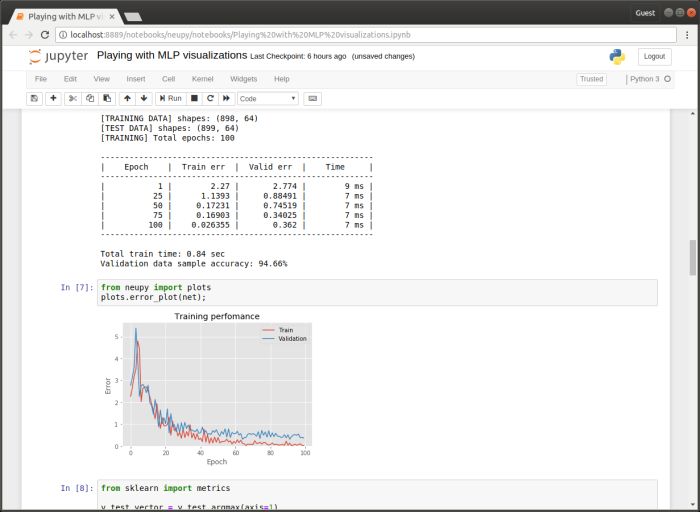
Neupy is written in Python. Learn Python with our recommended free books and free tutorials.
Related Software
| Deep Learning with Python | |
|---|---|
| TensorFlow | A very popular Deep Learning framework |
| PyTorch | Tensors and Dynamic neural networks in Python |
| Keras | High-level neural networks API |
| fastai | Simplifies training fast and accurate neural networks |
| tinygrad | Compact, lightweight deep learning framework |
| PyTorch Lightning | Framework for scaling PyTorch training workflows |
| JAX | High-performance numerical computing and ML library |
| PyTensor | Library for fast numerical computation |
| MindSpore | Framework for training and deploying neural networks |
| Elephas | Distributed deep learning with Keras and Spark |
| Chainer | Powerful, flexible, and intuitive framework for neural networks |
| Equinox | Neural network library for building flexible models with JAX |
| Caffe | Convolutional Architecture for Fast Feature Embedding |
| TFlearn | Deep learning library featuring a higher-level API for TensorFlow |
| MXNet | Flexible and efficient library |
| CNTK | Distributed deep learning |
| Neupy | Python library for neural networks and deep learning |
Read our verdict in the software roundup.
 Explore our comprehensive directory of recommended free and open source software. Our carefully curated collection spans every major software category. Explore our comprehensive directory of recommended free and open source software. Our carefully curated collection spans every major software category.This directory is part of our ongoing series of informative articles for Linux enthusiasts. It features hundreds of detailed reviews, along with open source alternatives to proprietary solutions from major corporations such as Google, Microsoft, Apple, Adobe, IBM, Cisco, Oracle, and Autodesk. You’ll also find interesting projects to try, hardware coverage, free programming books and tutorials, and much more. Discovered a useful open source Linux program that we haven’t covered yet? Let us know by completing this form. |
Please read our Comment Policy before commenting.