

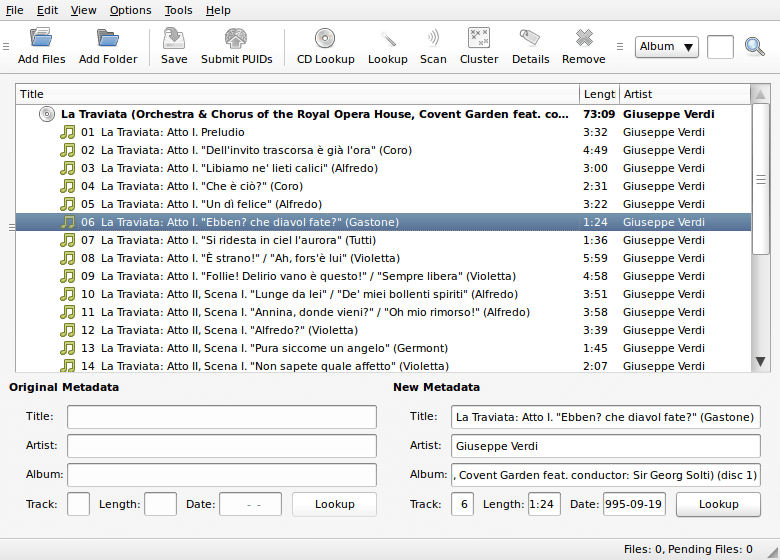
MusicBrainz Picard (“Picard”) is a cross-platform, open source, MusicBrainz tag editor written in the Python programming language.
Picard is intended to be the next generation of tagger for the MusicBrainz application, with a focus on album-oriented (as opposed to track-based) tagging and cross platform compatibility.
When tagging files, Picard uses an album-oriented approach. This approach allows it to use the MusicBrainz data effectively and correctly tag your music.
Key Features
- Supports the following formats:
- MP3, TTA (ID3).
- Ogg Vorbis, FLAC, Speex (Vorbis comment).
- Musepack, WavPack, OptimFROG, Monkey’s Audio (APEv2 tag).
- AAC, ALAC (MP4).
- The True Audio.
- Windows Media Audio.
- AIF.
- m2a.
- WAV.
- Automatic identification of audio files through the MusicDNS service using the Open Fingerprint Architecture acoustic fingerprinting technology.
- Manual lookups for more control over how your files are tagged.
- Performs CD lookups and disc ID submissions.
- Cover art.
- Plugins to extend functionality such as:
- Disc Numbers – moves (disc X) from releases titles into separate tags (discnumber and discsubtitle).
- Feat. Artists – removes (feat. Artist) parts from track titles.
- Cover Art Downloader – downloads cover art for optional tag embedding and/or saving as a separate image file.
- Last.fm Tags.
- Last.fm Plus.
- Search Plugins – launches searches for clusters or releases to external non-MB websites from Picard.
- Change Encoding – converts the tags of individual files or clusters between different character encodings.
- Live syntax checking for tagger script and naming strings.
- Support for audio fingerprints using AcoustIDs.
- Support ratings.
- Support for user folskonomy tags.
- Simple scripting.
- Use a web proxy.
- Multi-platform support – Linux, Mac OS X, and Windows
MusicBrainz Picard is named after the character Captain Jean-Luc Picard from the TV science fiction series Star Trek: The Next Generation.
Website: picard.musicbrainz.org
Support: Documentation, Quick Start, FAQ, GitHub
Developer: Lukáš Lalinský, Robert Kaye, Philipp Wolfer, Sambhav Kothari
License: GNU General Public License v2.0
MusicBrainz Picard is written in Python. Learn Python with our recommended free books and free tutorials.
Related Software
| Music Tag Editors | |
|---|---|
| MusicBrainz Picard | Cross-platform MusicBrainz tag editor written in Python |
| Kid3 | Highly efficient audio tagger |
| Beets | Music tagger and library organizer using the MusicBrainz database |
| Tag Editor | Tag editor with Qt GUI and command-line interface |
| puddletag | Similar to Mp3tag |
| EasyTAG | Tag editor for MP3, Ogg Vorbis files and more |
| Tagger | Simple GTK utility that lets you tag your music |
| One Tagger | Music tagger with Beatport, Discogs, Musicbrainz, Spotify support |
| Ear Tag | Primarily geared towards making quick edits or bulk-editing tracks |
| GabTag | Audio tagging tool written in GTK 3 |
| Qoobar | Simple tagger for classical music |
| NTag | Graphical audio file tag editor |
| idntag | Identify and tag audio files |
| htagcli | View, edit and validate metadata tags |
| Pinky-Tagger | Mass tagger which supports the MusicBrainz (PUID & TRM) service |
Read our verdict in the software roundup.
 Explore our comprehensive directory of recommended free and open source software. Our carefully curated collection spans every major software category. Explore our comprehensive directory of recommended free and open source software. Our carefully curated collection spans every major software category.This directory is part of our ongoing series of informative articles for Linux enthusiasts. It features hundreds of detailed reviews, along with open source alternatives to proprietary solutions from major corporations such as Google, Microsoft, Apple, Adobe, IBM, Cisco, Oracle, and Autodesk. You’ll also find interesting projects to try, hardware coverage, free programming books and tutorials, and much more. Discovered a useful open source Linux program that we haven’t covered yet? Let us know by completing this form. |
Please read our Comment Policy before commenting.