

A sound system is software that manages the use of and access to audio devices (usually a sound card). It commonly runs as a background process.
To provide an insight into the quality of software that is available, we have compiled a list of 6 high quality free and open source sound systems.
Here’s our verdict captured in a legendary LinuxLinks chart. We only feature open source goodness.
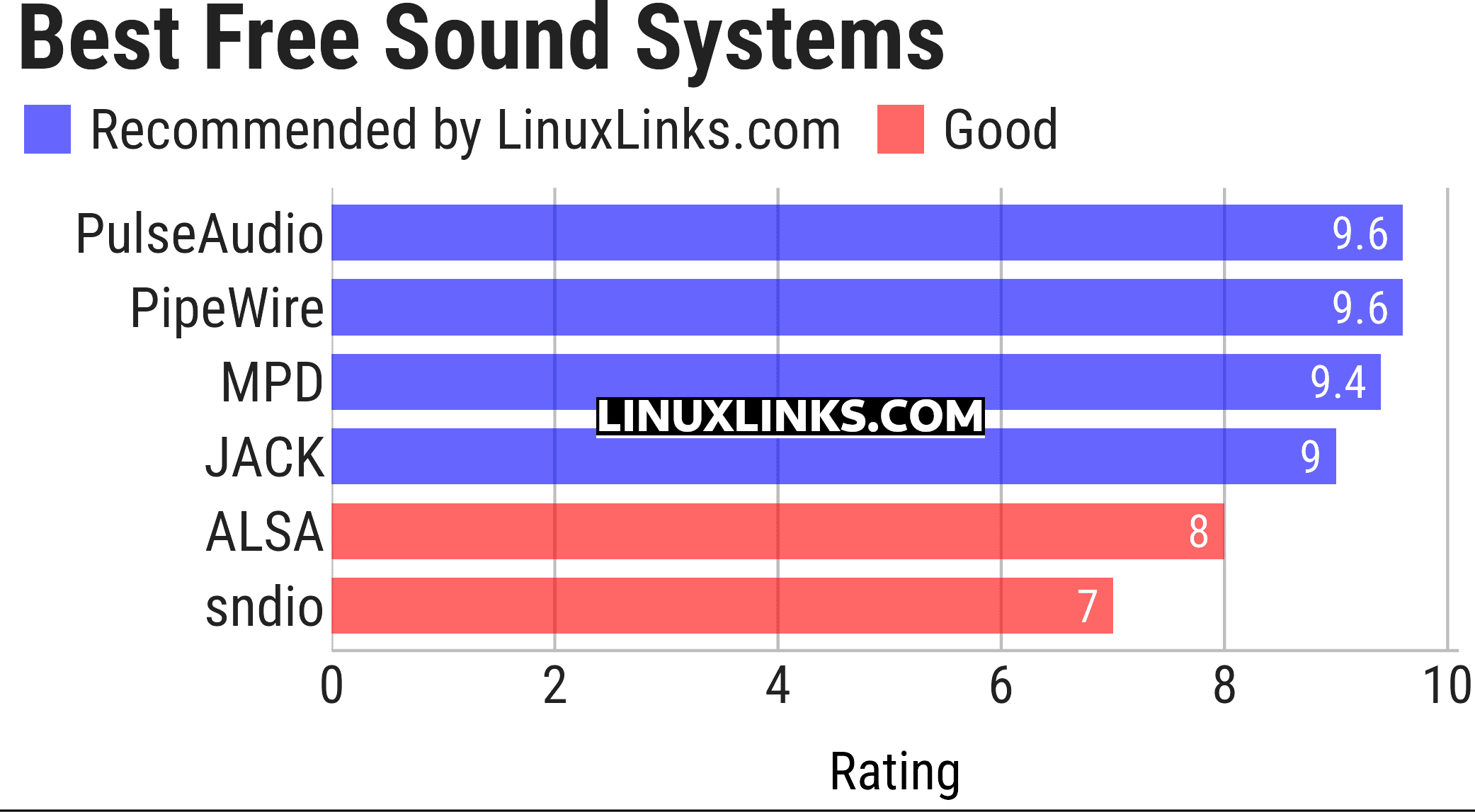
Let’s explore the 6 sound systems at hand. For each title we have compiled its own portal page, a full description with an in-depth analysis of its features, together with links to relevant resources.
| Audio Systems | |
|---|---|
| PulseAudio | Integral part of all relevant modern Linux distributions |
| PipeWire | Low-latency, graph based processing engine on top of audio and video devices |
| MPD | Flexible, powerful, server-side application for playing music |
| JACK | Professional low-latency sound server API and pair of daemon implementations |
| ALSA | Advanced Linux Sound Architecture |
| sndio | Small audio and MIDI framework |
This article has been updated to reflect the changes outlined in our recent announcement.
Background Information
In the Linux kernel, there have historically been two uniform sound APIs used, either ALSA or OSS. ALSA is responsible for giving audio to all modern Linux distributions. It’s part of the Linux kernel itself, providing audio functionality to the rest of the system via an application programming interface (API) for sound card device drivers. Up to the 2.4 series of Linux kernels, OSS was the main and only sound system for Linux.
PulseAudio is a general purpose sound server intended to run as a middleware between your applications and your hardware devices, either using ALSA or OSS.
We cover streaming servers such as Icecast in a separate feature.
 Explore our carefully curated directory of recommended free and open source software, covering every major software category. Explore our carefully curated directory of recommended free and open source software, covering every major software category.The directory forms part of our extensive collection of articles for Linux enthusiasts. It includes hundreds of detailed reviews, together with free and open source alternatives to proprietary software from companies such as Google, Microsoft, Apple, Adobe, IBM, Cisco, Oracle, and Autodesk. LinuxLinks also covers interesting projects worth exploring, Linux-compatible hardware, free programming books and tutorials, and much more. Know a useful free and open source Linux application that we haven’t covered? Tell us about it using our submission form. |
Please read our Comment Policy before commenting.