
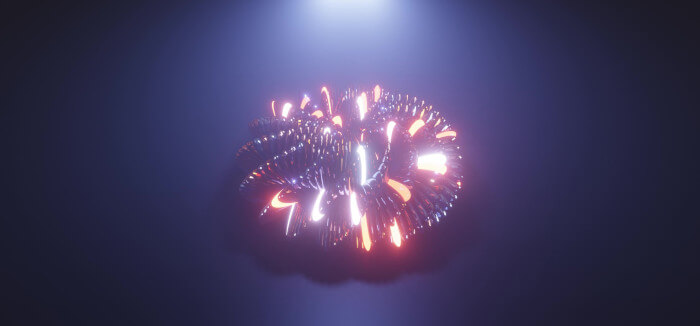
Ray tracing is a technique for modeling light transport for use in a wide variety of rendering algorithms for generating digital images. This allows computers to accurately render things like shadows, reflections, highlights, and bounced light. The result is a scene that looks more realistic with less work.
Shadows are softer, certain surfaces are more reflective and detailed, neon lights pop with more intensity. There are a wide variety of lighting effects ray tracing can handle: reflection, refraction, soft shadows, scattering, depth of field, motion blur, caustics, ambient occlusion, and dispersion phenomena.
On a spectrum of computational cost and visual fidelity, ray tracing-based rendering techniques from ray casting, recursive ray tracing, distribution ray tracing, photon mapping to path tracing are generally slower and higher fidelity than scanline rendering methods. Ray tracing was therefore first deployed in applications where taking a relatively long time to render could be tolerated, such as in still computer-generated images, and film and television visual effects (VFX), but was less suited to real-time applications such as video games, where speed is critical in rendering each frame. A good graphics card can use ray tracing to enhance immersion, but not all GPUs can handle this technique.
Here’s our verdict captured in a legendary LinuxLinks chart. We only include free and open source software.
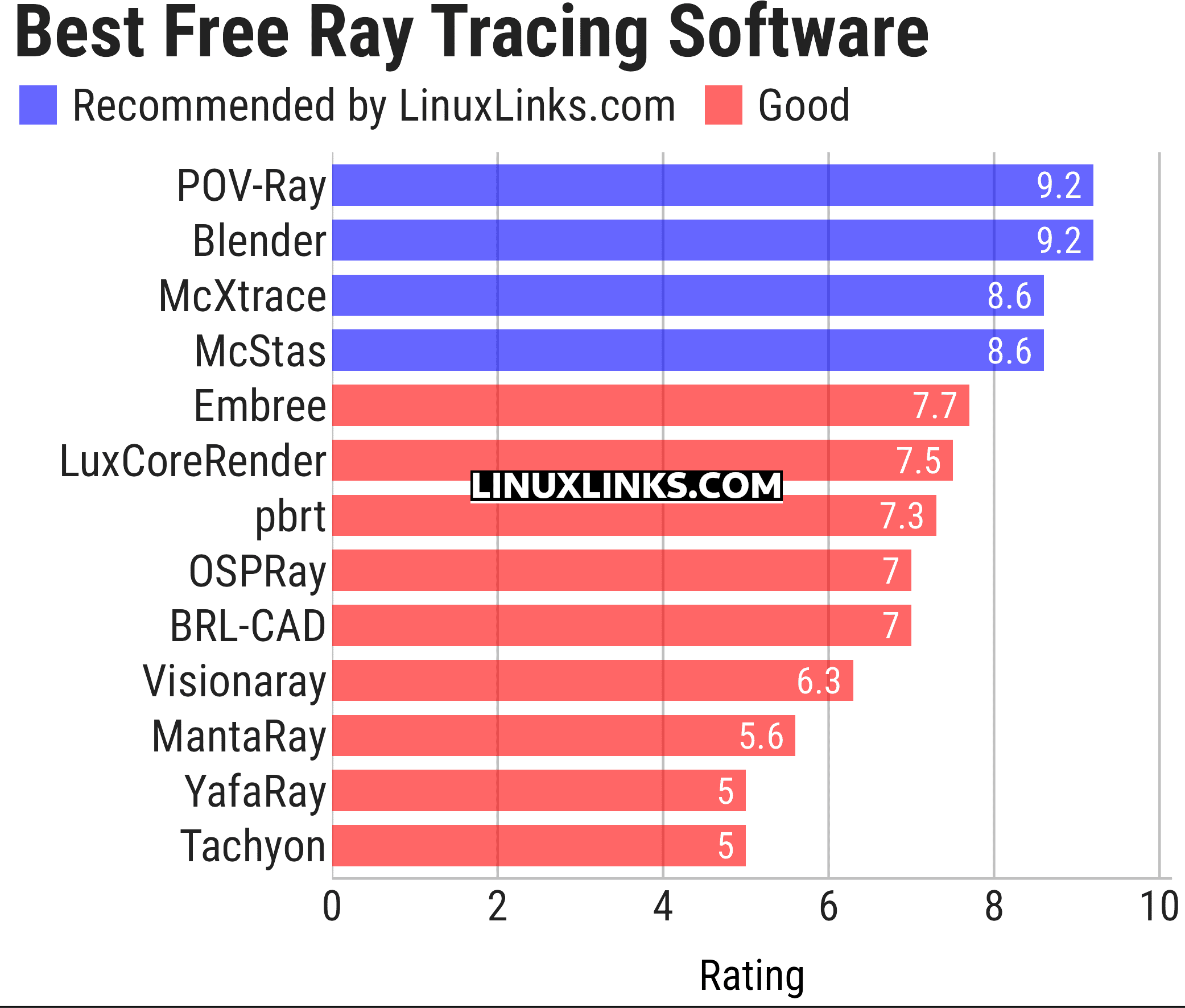
Let’s explore the 13 ray tracing tools. For each program we have compiled its own portal page, a full description with an in-depth analysis of its features, a screenshot of the program in action together with links to relevant resources.
| Ray Tracing Software | |
|---|---|
| POV-Ray | Full-featured ray tracer |
| Blender | 3D content creation suite with a huge range of uses |
| McXtrace | Monte Carlo Xray Tracing for simulation X-ray beamlines and experiments |
| McStas | Simulator for neutron scattering instruments and experiments |
| Embree | High-performance ray tracing library |
| LuxCoreRender | Rendering system for physically correct image synthesis |
| pbrt | Physically based ray tracing system |
| OSPRay | Scalable and portable ray tracing engine |
| BRL-CAD | Combinatorial Constructive Solid Geometry (CSG) solid modeling system |
| Visionaray | C++ ray tracing template library |
| MantaRay | Advanced renderer using modern rendering techniques |
| YafaRay | Montecarlo raytracing engine |
| Tachyon | Parallel / multiprocessor ray tracing system |
This article has been updated to reflect the changes outlined in our recent announcement.
 Explore our comprehensive directory of recommended free and open source software. Our carefully curated collection spans every major software category. Explore our comprehensive directory of recommended free and open source software. Our carefully curated collection spans every major software category.This directory is part of our ongoing series of informative articles for Linux enthusiasts. It features hundreds of detailed reviews, along with open source alternatives to proprietary solutions from major corporations such as Google, Microsoft, Apple, Adobe, IBM, Cisco, Oracle, and Autodesk. You’ll also find interesting projects to try, hardware coverage, free programming books and tutorials, and much more. Know a useful open source Linux program that we haven’t covered yet? Let us know by completing this form. |
Please read our Comment Policy before commenting.