

The software utility cron also known as cron job is a time-based job scheduler in Unix-like computer operating systems.
Users who set up and maintain software environments use cron to schedule jobs (commands or shell scripts) to run periodically at fixed times, dates, or intervals.
This software typically automates system maintenance or administration such as automating backups, cleaning disk space and other system maintenance tasks. It’s general purpose too making it good for things like downloading files from the Internet and downloading email at regular intervals.
Cron is most suitable for scheduling repetitive tasks. Scheduling one-time tasks can be accomplished using the associated at utility. For commands that need to be executed repeatedly (e.g., hourly, daily, or weekly), you can use the crontab command. The crontab command creates a crontab file containing commands and instructions for the cron daemon to execute.
Cron is a command line utility, but it’s not the only CLI command scheduler available for Linux. We feature alternatives to cron. The ratings chart captures our recommendations. Only free and open source software is eligible for inclusion.
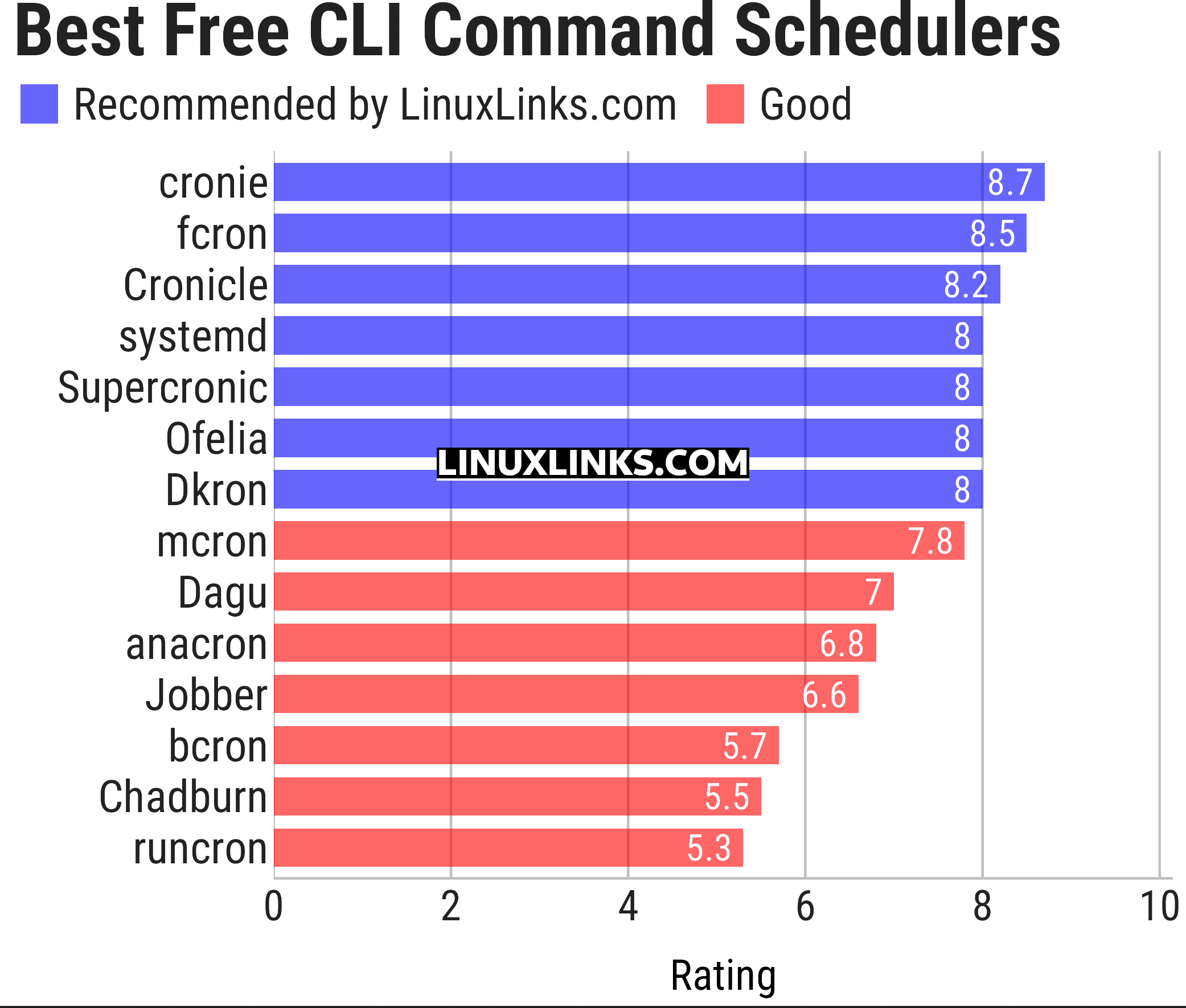
Let’s explore the CLI command schedulers at hand. Click the links in the table below to learn more about each program.
| Alternatives to cron | |
|---|---|
| cronie | Modern day version of cron and associated tools |
| fcron | Designed for systems which are not continuously running or regularly |
| Cronicle | Multi-server task scheduler and runner |
| systemd | Suite of basic building blocks for a Linux system |
| Supercronic | Crontab-compatible job runner designed for container environments |
| Ofelia | Low-footprint job scheduler for Docker environments |
| Dkron | Distributed job scheduling system for cloud native environments |
| mcron | 100% compatible replacement for Vixie cron |
| Dagu | Lightweight workflow orchestration engine |
| anacron | Designed for systems which are not continuously running |
| Jobber | Run commands to a schedule |
| bcron | Designed with secure operations in mind |
| Chadburn | Modern job scheduler for Docker environments |
| runcron | Minimal cron alternative for automated and container-friendly environments |
This article has been updated to reflect the changes outlined in our recent announcement.
 Explore our carefully curated directory of recommended free and open source software, covering every major software category. Explore our carefully curated directory of recommended free and open source software, covering every major software category.The directory forms part of our extensive collection of articles for Linux enthusiasts. It includes hundreds of detailed reviews, together with free and open source alternatives to proprietary software from companies such as Google, Microsoft, Apple, Adobe, IBM, Cisco, Oracle, and Autodesk. LinuxLinks also covers interesting projects worth exploring, Linux-compatible hardware, free programming books and tutorials, and much more. Know a useful free and open source Linux application that we haven’t covered? Tell us about it using our submission form. |
Please read our Comment Policy before commenting.