

There’s a vast array of free and open-source music software available on the Linux platform, offering both maturity and sophistication. Linux boasts numerous music tools that provide enhanced functionality and seamless integration with various internet music services. With most desktop environments equipped with multiple audio players, alongside cross-platform applications and integrated media players, you’ll find yourself spoiled for choice when it comes to music players.
Every music library is unique, and selecting the right open-source music player can truly elevate your listening experience, especially if you have a large collection.
Ampere is a native GUI-based playlist-based audio player written in Python and Qt. It’s free and open source software that runs on Linux and Windows.
Installation
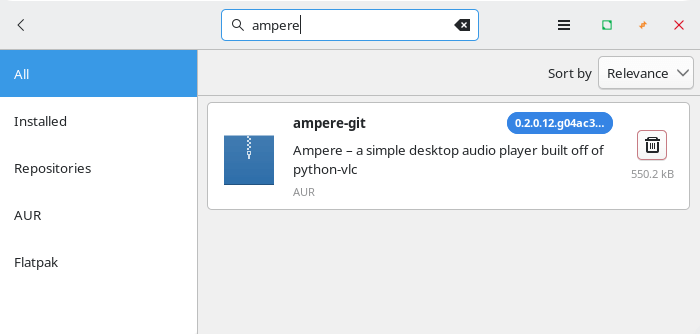
I evaluated Ampere with the Manjaro distribution. There’s a package in the Arch User Repository which builds with no issues.
While the program is also available for Windows, my testing is restricted to Linux.
In Operation
It’s easy to get started. I loaded my CC-licensed small music library using File / Folder. This action creates a playlist with all the tracks in the folders. The software recursively scans folders. The program supports common music formats including the indispensable lossless FLAC (as well as MP3, OGG, WAV, M4A, AAC)
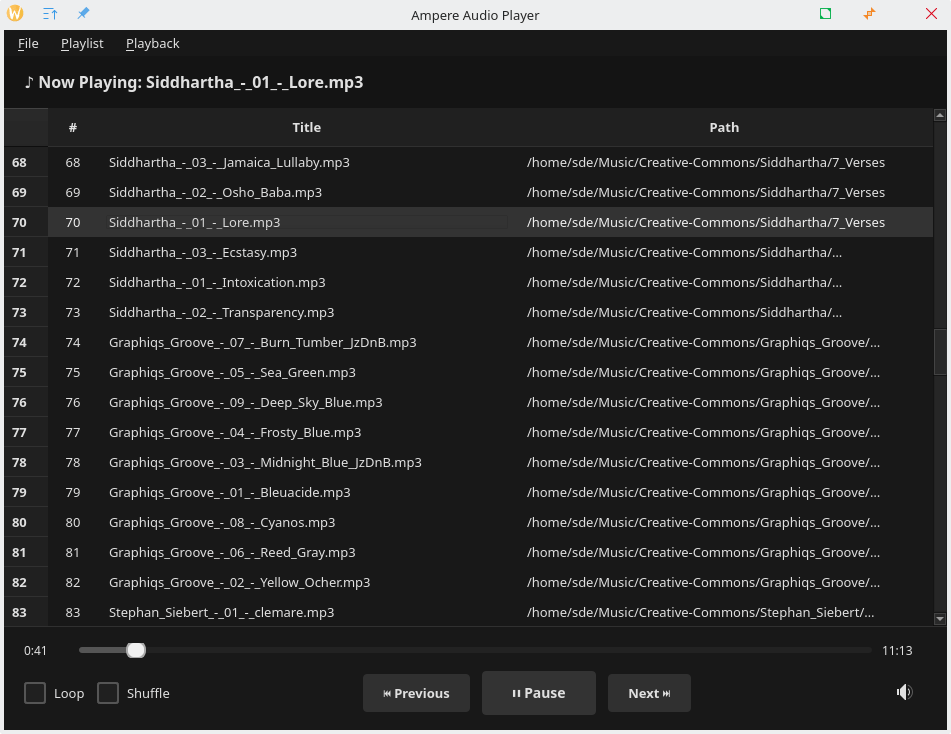
Unfortunately the program doesn’t load albums in their correct track order and dragging tracks doesn’t seem to work properly.
The first thing I check out is whether or not gapless playback is supported. Gapless playback is the uninterrupted playback of consecutive audio tracks, such that relative time distances in the original audio source are preserved over track boundaries on playback. It’s essential if you listen to classical, electronic music, concept albums, and progressive rock. There are a few Linux music players that don’t offer gapless playback.
The gapless playback dialog says that “Ampere already advances to the next track as soon as playback ends. True fully gapless playback still requires a raw-audio backend, but crossfade/ReplayGain settings are now modeled in the player”. By default the crossfade duration is set to 0.0, and the ReplayGain mode is off. From my initial testing, there is a noticeable audio gap between tracks irrespective of the crossfade settings. The player doesn’t support gapless playback in its current form.
Other features include:
- Playlists with support for Shuffle playback.
- Streaming URL support which is useful for listening to internet radio stations. You have to specify the URL. Hopefully more convenient ways of listening to radio stations are added in the future.
- Keyboard controls.
- The dreaded equalizer.
Summary
Ampere is a simple audio player that’s in an early stage of development. The fact that its UI is spartan might actually be a plus as it’s very simple to use. I hope with maturity the obvious bugs are fixed. And the lack of gapless playback is a showstopper (at least for me). There are many Python-based music players that offer gapless playback. libVLC/VLC is infamous for not providing true gapless playback.
I’ll keep an eye on future developments.
For the finest GUI-based Linux music players check out this roundup.
Website: github.com/hent83722/ampere-audio-player
Support:
Developer: Henri
License: MIT License
Ampere is written in Python. Learn Python with our recommended free books and free tutorials.