

Last Updated on March 3, 2026
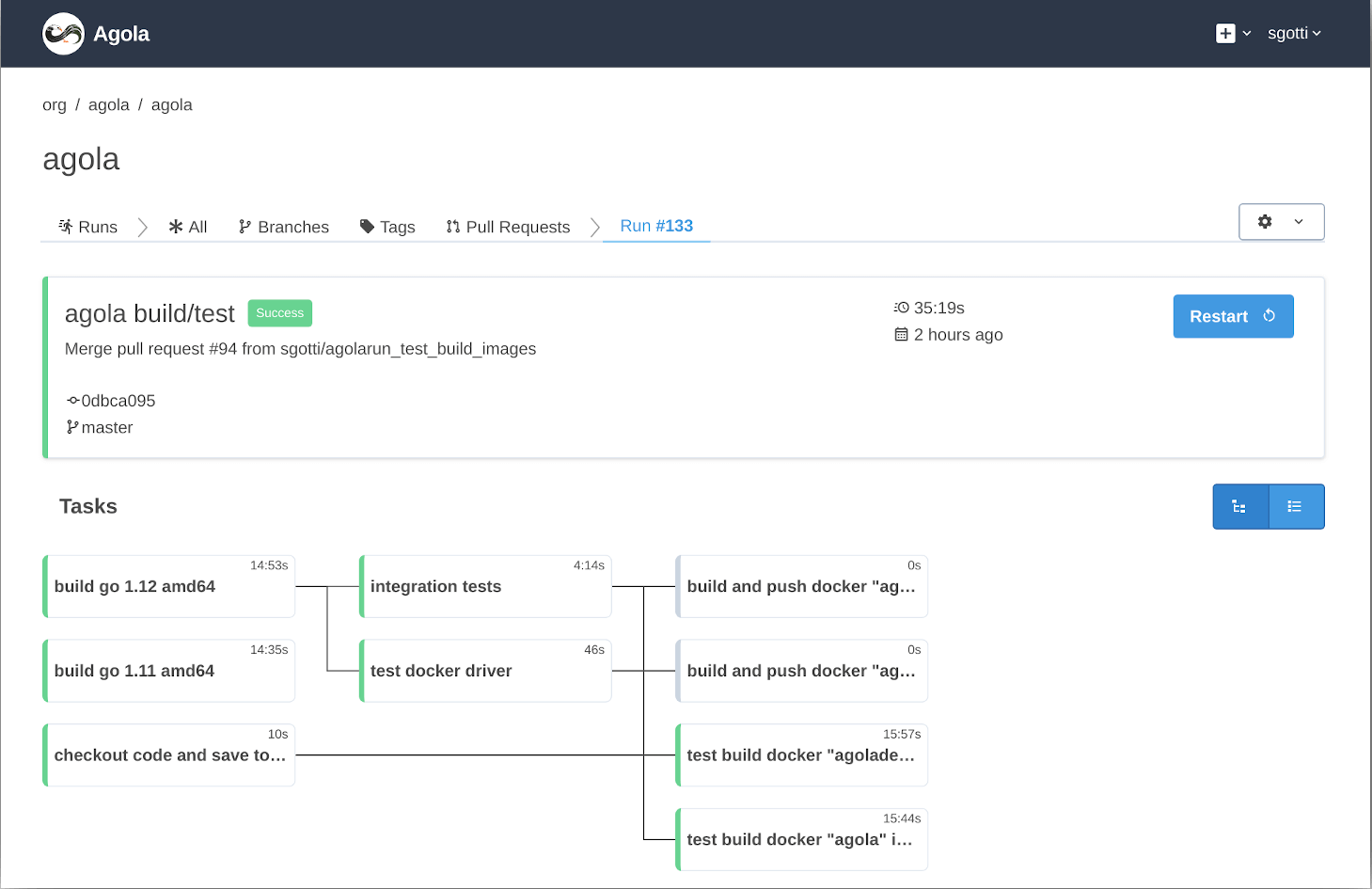
Agola is a CI/CD system with a lot of features like advanced and reproducible workflows (runs), containerized tasks, fully distributed and high-available.
This is free and open source software.
Key Features
- Easy to install and manage.
- Scalable and High Available: go from a single instance (single process) deployment to a distributed deployment.
- Deploy anywhere: Kubernetes, IaaS, bare metal and execute the “tasks” anywhere (currently containers executors like docker or orchestrators and Kubernetes, but easily extensible to future technologies or VMs instead of containers).
- Support any language, deployment system etc.
- Integrate with multiple git providers at the same time: you could add repos from github, gitlab, gitea (and more to come) inside the same agola installation.
- Use it to manage the full development lifecycle: from build to deploy.
- Tasks Workflows (that we called Runs) with ability to achieve fan-in, fan-out, matrixes etc…, everything containerized to achieve maximum reproducibility.
- Git based workflow: the run definition is committed inside the git repository (so everything is tracked and reproducible). A run execution is started by a git action (push, pull-request).
- Design it with the ability to achieve at most once runs: during a deployment to production we don’t want multiple concurrent execution of the deploy…
- Containerized, reproducible and restartable Runs (restart a run from scratch or from failed tasks using the same source commit, variables etc…)
- User Direct Runs: give every user the power to test their software using the same run definition used when pushing to git/opening a pull request inside the Agola installation with just one command like if they were running tests locally (without requiring a super powerful workstation).
- Testable “Runs” (what is a CI/CD environment if you cannot test your changes to the Runs definitions?): use the same run definition but use a powerful secrets and variables system to access different resources (environments, docker registries etc…).
- An advanced permissions system (work in progress).
- Dependency Caching to speed up tasks.
Website: agola.io
Support: GitHub Code Repository
Developer: Sorint.lab S.p.A.
License: Apache License 2.0
Agola is written in Go. Learn Go with our recommended free books and free tutorials.
Related Software
| Continuous Integration Tools | |
|---|---|
| Jenkins | Self-contained automation server with an awesome array of plugins |
| Buildbot | Python-based continuous integration testing framework |
| Tekton | Powerful and flexible framework for creating CI/CD systems |
| Earthly | CI/CD framework that runs every pipeline inside containers |
| Dagger | Powerful, programmable CI/CD engine |
| GoCD | Easily model and visualize complex workflows |
| Concourse | Presents a general approach to automation for CI/CD |
| Woodpecker | Uses docker containers to execute pipeline steps |
| Agola | CI/CD redefined |
| Semaphore | Self-hosted continuous integration and delivery platform |
| Laminar | Lightweight and modular Continuous Integration service |
| Zuul | Project gating system |
| Prow | Kubernetes-based continuous integration and continuous delivery system |
Read our verdict in the software roundup.
| Continuous Delivery Tools | |
|---|---|
| Jenkins | Self-contained, open source automation server with a huge array of plugins |
| Argo CD | Declarative GitOps continuous delivery tool |
| Tekton | Powerful and flexible framework for creating CI/CD systems |
| Earthly | CI/CD framework that runs every pipeline inside containers |
| Dagger | Powerful, programmable CI/CD engine |
| GoCD | Easily model and visualize complex workflows |
| Spinnaker | Cloud native continuous delivery |
| Concourse | Presents a general approach to automation for CI/CD |
| Flux | Continuous delivery and GitOps toolkit for Kubernetes |
| Woodpecker | Uses docker containers to execute pipeline steps |
| Agola | CI/CD redefined |
| Screwdriver | Build platform designed for Continuous Delivery |
| PipeCD | GitOps-style continuous delivery platform |
Read our verdict in the software roundup.
 Explore our comprehensive directory of recommended free and open source software. Our carefully curated collection spans every major software category. Explore our comprehensive directory of recommended free and open source software. Our carefully curated collection spans every major software category.This directory is part of our ongoing series of informative articles for Linux enthusiasts. It features hundreds of detailed reviews, along with open source alternatives to proprietary solutions from major corporations such as Google, Microsoft, Apple, Adobe, IBM, Cisco, Oracle, and Autodesk. You’ll also find interesting projects to try, hardware coverage, free programming books and tutorials, and much more. Discovered a useful open source Linux program that we haven’t covered yet? Let us know by completing this form. |
Please read our Comment Policy before commenting.