

Mitsuba is an extensible rendering framework written in portable C++. It implements unbiased as well as biased techniques and contains heavy optimizations targeted towards current CPU architectures.
Mitsuba comes with a command-line interface as well as a graphical frontend to interactively explore scenes. While navigating, a rough preview is shown that becomes increasingly accurate as soon as all movements are stopped. Once a viewpoint has been chosen, a wide range of rendering techniques can be used to generate images, and their parameters can be tuned from within the program.
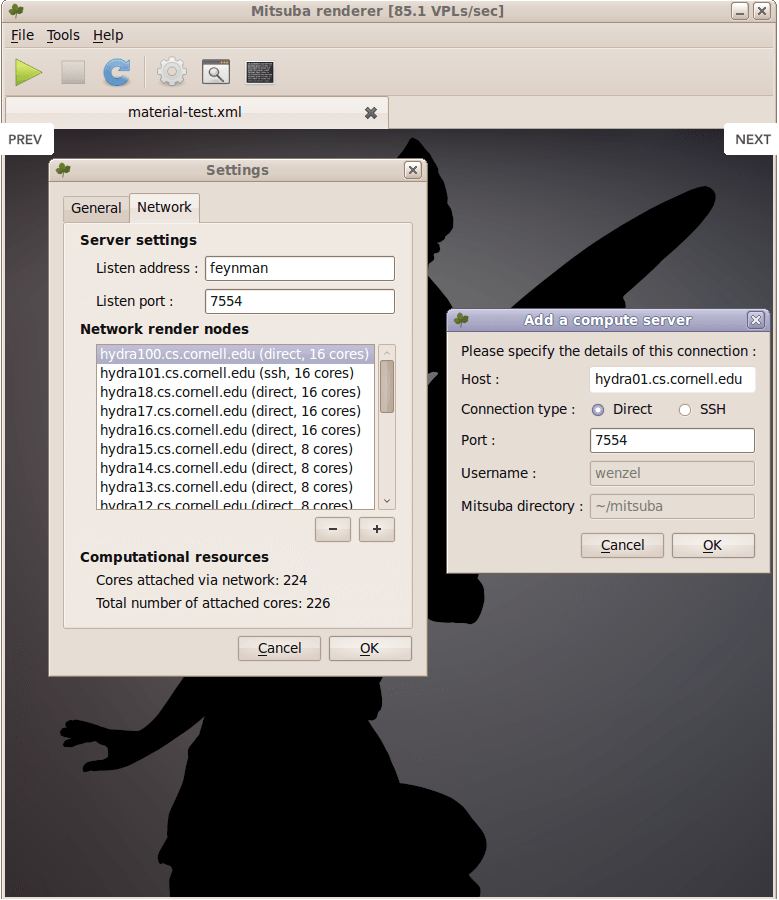
Mitsuba can transparently distribute work over a cluster without the need for a shared filesystem. Most implemented algorithms can be run in parallel over massive numbers of networked cores.
Key Features
- Available rendering techniques:
- Direct illumination.
- Monte-Carlo path tracer which solves the full Radiative Transfer Equation.
- Photon mapper with irradiance gradients.
- Adjoint particle tracer.
- Instant Radiosity (hardware-accelerated).
- Progressive Photon Mapper.
- Stochastic Progressive Photon Mapper.
- Veach-style Bidirectional Path Tracer.
- Kelemen-style Metropolis Light Transport.
- Veach-style Metropolis Light Transport.
- Supports the most commonly used scattering models: Lambertian surfaces, ideal dielectrics & mirrors as well as the the Phong & anisotropic Ward BRDFs.
- Compute global illumination solutions in scenes containing large isotropic or anisotropic participating media.
- Internally uses a O(n log n) SAH kd-tree compiler with support for primitive clipping (aka. perfect splits). The ray tracing core is built on Havran’s fast traversal algorithm.
- Data exchange with the major modeling packages is supported using the COLLADA file format. Mitsuba can read DAE files and convert them into its native XML-based file format.
- Spectral rendering, black body radiation and dispersion.
- Customizable image reconstruction filters.
- High dynamic-range input/output using the OpenEXR format.
- Deterministic Quasi-Monte Carlo sampling.
- Adaptive integration.
- Depth of field.
Website: www.mitsuba-renderer.org
Support: Documentation
Developer: Wenzel Jakob
License: GNU General Public License v3.0
Mitsuba is written in C++. Learn C++ with our recommended free books and free tutorials.
Related Software
| Renderers | |
|---|---|
| Blender | 3D computer graphics software toolset that excels in many areas |
| Cycles | Physically based production renderer developed by the Blender project |
| Mitsuba | Extensible rendering framework written in portable C++ |
| LuxCoreRender | Physically based and unbiased rendering engine |
| MoonRay | Production path-tracing renderer |
| pbrt | Physically based ray tracing system |
| Malt | Fully customizable real-time rendering framework |
| Art of Illusion | 3D-modeler, renderer and raytracer |
| appleseed | Physically-based renderer targeted at production rendering |
| Renderer | Interactive 3D visualization of triangle meshes |
| Radiance | Suite of tools for performing lighting simulation |
| MiniLight | Minimal global illumination renderer |
| MantaRay | Advanced renderer which uses modern rendering techniques |
| Aqsis | 3D rendering solution adhering to the RenderMan standard |
Read our verdict in the software roundup.
 Explore our carefully curated directory of recommended free and open source software, covering every major software category. Explore our carefully curated directory of recommended free and open source software, covering every major software category.The directory forms part of our extensive collection of articles for Linux enthusiasts. It includes hundreds of detailed reviews, together with free and open source alternatives to proprietary software from companies such as Google, Microsoft, Apple, Adobe, IBM, Cisco, Oracle, and Autodesk. LinuxLinks also covers interesting projects worth exploring, Linux-compatible hardware, free programming books and tutorials, and much more. Know a useful free and open source Linux application that we haven’t covered? Tell us about it using our submission form. |
Please read our Comment Policy before commenting.