
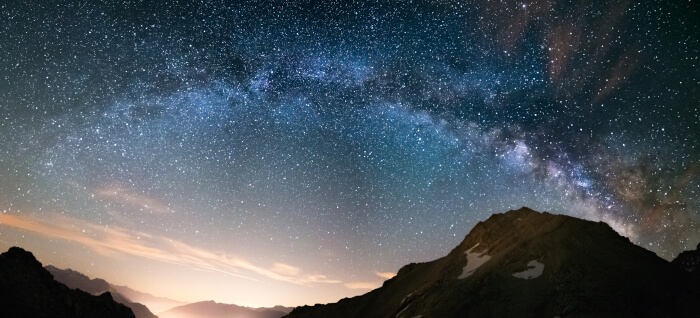
Celestia is an open source real-time space simulation that lets you visually experience the universe in three dimensions.
Unlike most planetarium software, Celestia does not confine you to the surface of the Earth. You can travel throughout the solar system, to any of over 100,000 stars, or even beyond the galaxy. All travel in Celestia is seamless; the exponential zoom feature lets you explore space across a huge range of scales, from galaxy clusters down to spacecraft only a few meters across. A ‘point-and-goto’ interface makes it simple to navigate through the universe to the object you want to visit.
Many add-ons and vastly improved textures of high resolution are available for Celestia.
NASA and ESA have used Celestia in their educational and outreach programs, as well as for interfacing to trajectory analysis software.
It has GNOME, KDE, and generic Gimp Toolkit (Gtk) front ends.
Millions of people have downloaded the program for use at home or school. It’s in use in homes, schools, government agencies and media outlets throughout the world.
Key Features
- Displays the Hipparcos Catalogue of almost 120,000 stars.
- Globular cluster catalog containing all 150 globular clusters of the Milky Way.
- Uses the very accurate VSOP87 theory of planetary orbits to provide a Solar and lunar eclipse .finder and to display the orbital paths of planets (including extrasolar planets), moons, asteroids, comets, artificial satellites, and spacecraft.
- Travel/fly through the Celestia universe using simple keyboard controls, at any speed from 0.001m/s to millions of light years.
- Names and positions of multitudes of objects in space can be displayed, from galaxies, star clusters, nebula, constellations and stars to planets, moons, asteroids, comets and artificial satellites, as well as the names and locations of cities, craters, observatories, valleys, landing sites, continents, mountains, seas and other surface features.
- Displays features such as detailed atmospheres on planets and moons, sunsets and sunrises, moving clouds, planetary rings, eclipse and ring shadows, constellation lines, borders and
illustrations, night-side lights, detailed surface textures, nebula gases and star flares. - Information about the objects that Celestia draws can also be displayed: the radius, the distance, length of the sidereal day and average temperature of the planets are shown and the distance, luminosity relative to the sun, spectral class, surface temperature and radius of stars are indicated.
- Graphic screen-shots and movies can be captured in classic or HD resolutions.
- Extended with new objects and there are hundreds of third-party, user-created add-ons available for installation, both fictional and realistic.
- Supports triaxial ellipsoid bodies.
- Reference marks augment the 3D view with additional information that can help you understand the locations and relationships between solar system objects.
Website: celestia.space
Support: Forums, Celestia Motherlode, Selden’s List of Resources for Celestia
Developer: Celestia Development Team
License: GNU GPL v2 or later version
Celestia is written in C++. Learn C++ with our recommended free books and free tutorials.
Related Software
| Astronomy Software | |
|---|---|
| Stellarium | A virtual planetarium |
| Gaia Sky | Astronomy visualization desktop and VR program |
| Celestia | Real-time space simulation |
| AstroImageJ | Tool for astronomical image analysis and precise photometry |
| Skychart | Prepare different sky maps for a particular observation |
| KStars | Desktop planetarium for KDE |
| OpenSpace | Interactive data visualization software |
| Aladin Desktop | Interactive sky atlas |
| Virtual Moon Atlas | Real-time moon observation |
| Ginga | FITS image viewer and toolkit |
| Digital Universe Atlas | Standalone 4-dimensional space visualization application |
| XEphem | Motif based ephemeris and planetarium program |
| mars-sim | General purpose simulator |
| Cosmonium | 3D astronomy and space exploration program |
| Tenmon | FITS and XISF image viewer, converter and indexer |
| Kosmorro | Calculate your ephemerides |
| Astra | Observatory control system |
| astroterm | Terminal-based star map |
| Skyviewer | Displays HEALPix-based skymaps |
| skyterm | Terminal-based astronomy program |
| ORSA | Framework for celestial mechanics investigations |
Read our verdict in the software roundup.
 Explore our comprehensive directory of recommended free and open source software. Our carefully curated collection spans every major software category. Explore our comprehensive directory of recommended free and open source software. Our carefully curated collection spans every major software category.This directory is part of our ongoing series of informative articles for Linux enthusiasts. It features hundreds of detailed reviews, along with open source alternatives to proprietary solutions from major corporations such as Google, Microsoft, Apple, Adobe, IBM, Cisco, Oracle, and Autodesk. You’ll also find interesting projects to try, hardware coverage, free programming books and tutorials, and much more. Discovered a useful open source Linux program that we haven’t covered yet? Let us know by completing this form. |
Please read our Comment Policy before commenting.