

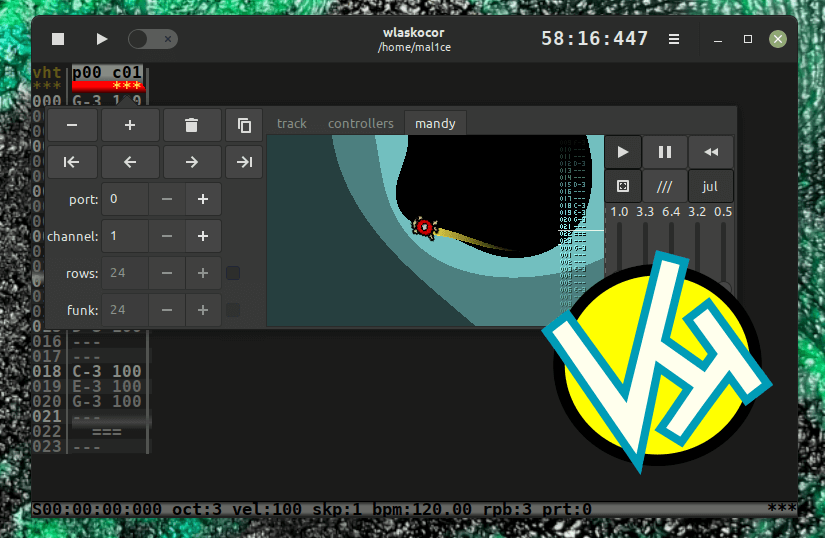
Vahatraker is a MIDI sequencing companion for Linux audio setups. Adhering to UNIX philosophy, driving MIDI is the one thing it tries to do well, adhering to other doctrines.
Vahatraker was envisaged as a re-creation of seq24 in tracker form for author’s “studio needs” and offers similar functionality (and limitations). It relies 100% on JACK audio connection kit for input/output/synch and uses jack_capture for rendering. The GUI has similar dependencies as gnome-calculator and tracker paradigm was chosen to allow for rhythmic gymnastics otherwise hard to convey.
This is free and open source software.
Key Features
- Live editing.
- Fast workflow.
- Intuitive midi-in.
- Unheard of time signatures.
- Scenes.
- Fractal turtles.
Website: github.com/rdybka/vht
Support:
Developer: Remigiusz Dybka
License: GNU General Public License v3.0
Vahatraker is written in Python and C. Learn Python with our recommended free books and free tutorials. Learn C with our recommended free books and free tutorials.
Related Software
| DJ Software | |
|---|---|
| Mixxx | Designed for both professional and amateur DJs with powerful features |
| Giada | Hardcore audio tool for DJs, live performers and electronic musicians |
| xwax | Digital Vinyl System |
| IDJC | Shoutcast/Icecast client with two main media players |
| terminatorX | Realtime audio synthesizer; “scratch” on digitally sampled audio data |
| Luppp | Music creation tool, intended for live use |
| Linux Show Player | Cue player designed for stage productions |
| Vahatraker | Live MIDI sequencer |
| ShoopDaLoop | Advanced live looping application with DAW-like elements |
| Seq24 | Minimal loop based midi sequencer |
| Chipdisco | Dual-deck DJ app for tracker modules |
Read our verdict in the software roundup.
 Explore our comprehensive directory of recommended free and open source software. Our carefully curated collection spans every major software category. Explore our comprehensive directory of recommended free and open source software. Our carefully curated collection spans every major software category.This directory is part of our ongoing series of informative articles for Linux enthusiasts. It features hundreds of detailed reviews, along with open source alternatives to proprietary solutions from major corporations such as Google, Microsoft, Apple, Adobe, IBM, Cisco, Oracle, and Autodesk. You’ll also find interesting projects to try, hardware coverage, free programming books and tutorials, and much more. Discovered a useful open source Linux program that we haven’t covered yet? Let us know by completing this form. |