
Last Updated on January 5, 2026
Software security testing involves evaluating and examining a system to identify potential security risks and vulnerabilities affecting both the system itself and its data. While terminology can vary, we’ll refer to assessments as the process of analyzing and uncovering vulnerabilities without attempting to exploit them. Conversely, we define testing as the process of not only identifying these vulnerabilities but also trying to exploit them.
Security testing is typically categorized based on the type of vulnerability being examined or the nature of the testing being conducted. Here’s a common breakdown:
- Vulnerability Assessment: This involves scanning and evaluating the system for any security issues. We have a separate roundup for Vulnerability Analysis Tools.
- Penetration Testing: Here, the system is subjected to analysis and simulated attacks to emulate the actions of malicious attackers. We have a dedicated roundup for Vulnerability Detection Tools
- Runtime Testing: During this phase, testing and analysis are performed based on end-user interactions with the system.
- Code Review: This step involves a thorough examination of the system’s code, focusing specifically on identifying security vulnerabilities.
The software featured in this article is not intended to cover tools explored in the above roundups.
Here’s some useful software for performing security testing. Our verdict is captured in a legendary LinuxLinks-style ratings chart. Only free and open source software is eligible for inclusion here.
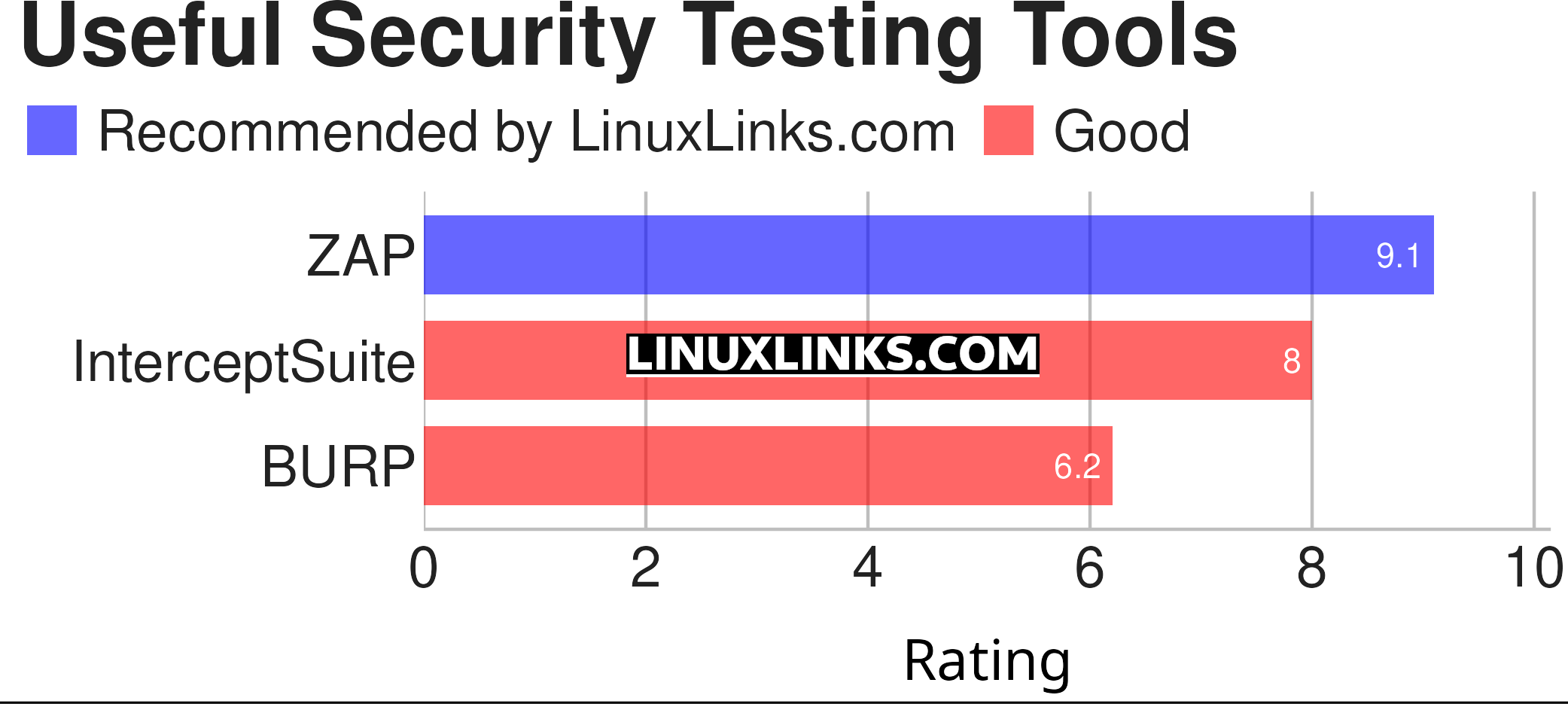
Click the links in the table below to learn more about each tool.
| Security Testing | |
|---|---|
| ZAP | Web app scanner |
| InterceptSuite | Network traffic interception tool |
| BURP | Accelerate application security testing |
 Explore our comprehensive directory of recommended free and open source software. Our carefully curated collection spans every major software category. Explore our comprehensive directory of recommended free and open source software. Our carefully curated collection spans every major software category.This directory is part of our ongoing series of informative articles for Linux enthusiasts. It features hundreds of detailed reviews, along with open source alternatives to proprietary solutions from major corporations such as Google, Microsoft, Apple, Adobe, IBM, Cisco, Oracle, and Autodesk. You’ll also find interesting projects to try, hardware coverage, free programming books and tutorials, and much more. Know a useful open source Linux program that we haven’t covered yet? Let us know by completing this form. |