
A Text-based User Interface (TUI) provides a structured way to engage with a computer through text characters. Unlike a basic Command-Line Interface (CLI), a TUI utilizes the entire screen, incorporating menus, panels, and colors for better visual organization. While it still relies on keyboard input and text, it enhances the user experience by creating a more advanced terminal setting that connects the simplicity of commands with the richness of graphical interfaces (GUIs).
The software featured in this roundup helps developers create TUI programs. There is a diverse range of programs included, mostly best described as frameworks. Rust is a versatile programming language that’s gaining popularity for its strong focus on performance and safety. It’s designed to ensure type safety and offers excellent support for concurrency, making it a great choice for high-performance applications.
The language embraces various programming paradigms and takes inspiration from functional programming. Features such as immutability, higher-order functions, algebraic data types, and pattern matching enrich its capabilities, allowing developers to write clean and efficient code.
Here’s our verdict captured in a legendary LinuxLinks-style ratings chart. Only free and open source software is eligible for inclusion.
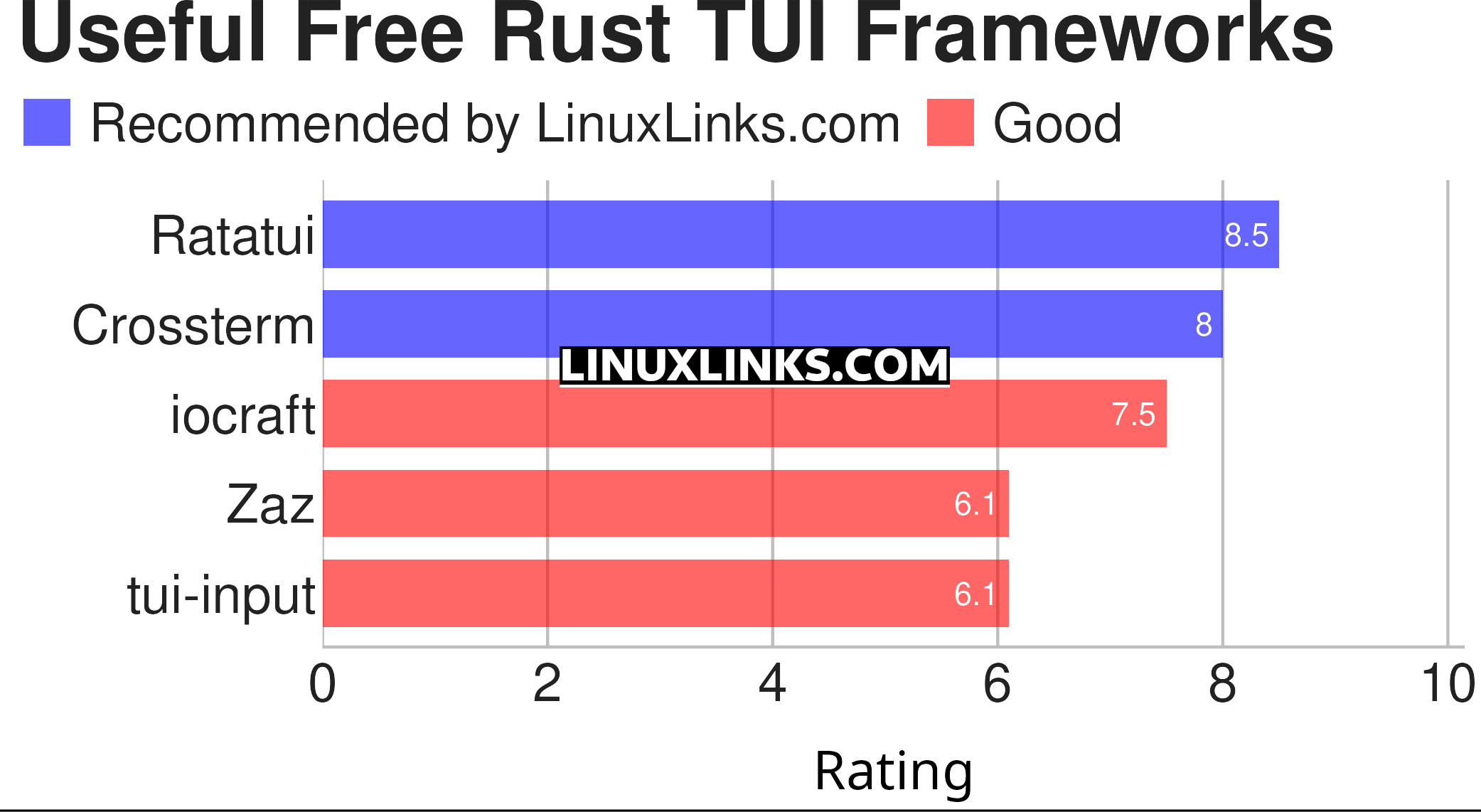
Click the links in the table below to learn more about each tool.
| Rust TUI Frameworks | |
|---|---|
| Ratatui | Simple and flexible way to create text-based user interfaces in the terminal |
| Crossterm | Terminal manipulation library |
| iocraft | Craft CLIs, TUIs, and text-based IO |
| Zaz | Terminal manipulation library |
| tui-input | Library supporting multiple backends |
 Explore our comprehensive directory of recommended free and open source software. Our carefully curated collection spans every major software category. Explore our comprehensive directory of recommended free and open source software. Our carefully curated collection spans every major software category.This directory is part of our ongoing series of informative articles for Linux enthusiasts. It features hundreds of detailed reviews, along with open source alternatives to proprietary solutions from major corporations such as Google, Microsoft, Apple, Adobe, IBM, Cisco, Oracle, and Autodesk. You’ll also find interesting projects to try, hardware coverage, free programming books and tutorials, and much more. Know a useful open source Linux program that we haven’t covered yet? Let us know by completing this form. |