
Last Updated on August 27, 2023
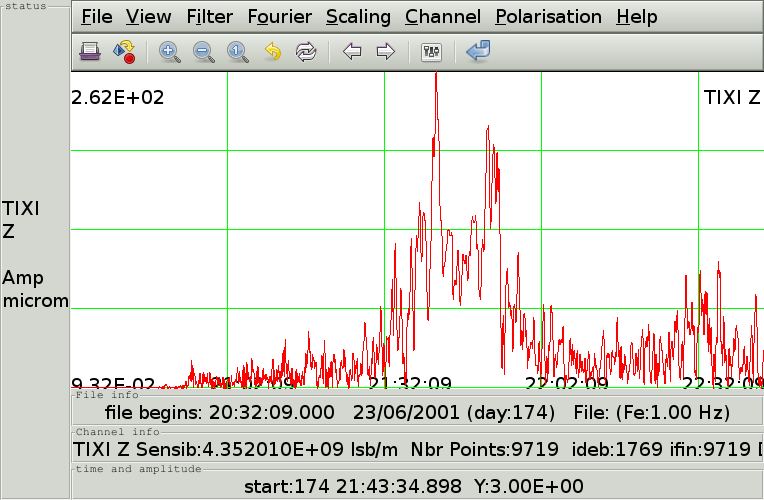
Seismic Toolkit (STK) is an open source tool for seismic signal processing in a graphical interface.
It reads seismic signals in SAC format, and provides a variety of signal processing, such as filtering, spectral analysis, polarisation analysis, time-frequency representation, Hilbert transform, and singular value decomposition.
Some utilities are included for useful seismological applications, such as computation of Seismic Moment Mo, Mantle magnitude Mm and Moment magnitude Mw, MTPA spectral analysis, plotting focal mechanisms, computation (and plotting) of instrumental response from poles and zeros, and some usefull GMT (Generic Mapping Tool) scripts for plotting signals, responses, and time-frequency in Postscript files for high quality prints.
Features include:
- Powerful Data Handling – The Seismic Toolkit accesses its data through a published data interface.
- Trace display type – INT new fast rasterizer engine supports the following display types: wiggle, variable area, variable density, interpolated density, color filled modes, or combinations.
- Built-in Processing Functions supporting a flexible trace processing pipeline to handle processes such as trace scaling, interpolation, filtering or Automatic Gain Control. Each process module is an object that can be individually controlled. Applications can replace any default module with their own.
- Conversion of segy file trace header coordinates from one datum to another datum and/or from one UTM zone to another onespan.
- Segy header viewer and editor.
- Over 200 datums and seven different projections supported.
- Graphic Overlays – overlay any number of seismic datasets, display interpretation or annotation data, and overlay logs or contours using the WellLog or the Contour toolkits.
- Local Trace Manipulation – Each trace can be positioned independently. User has control of trace highlight, polarity, visibility, color on a trace-by-trace basis. Fast local trace update.
- Virtual Scrolling – offers fast display of large sections with unlimited zooming in on a dataset. An image mode pre-rasterizes the data into an image buffer for faster scrolling or for using into movie loops.
- Orientation – support for drawing seismic traces from left to right, right to left, bottom to top or top to bottom.
- Editing – Editor panels are provided to edit the attributes of a section, including setting the display type, controlling the scaling of the data, setting the range of the data, or setting the interpolation mode. A color editor is available to dynamically update the colormap.
- Hardcopy Output – EPS is standard and CGM+ is a fully supported option.
- Qt Integration.
Website: seismic-toolkit.sourceforge.net (site down?)
Support:
Developer: Dominique Reymond
License: GNU GPL v2
| Explore Linux | |
|---|---|
 | Best Free and Open Source Software - A huge collection of recommended free and open source software covering every major category. |
 | In-depth Linux Software Reviews - Detailed assessments of Linux software covering features, usability and overall quality. |
 | The Big List of Active Linux Distros - An extensive collection of actively developed Linux distributions. |
 | Open Source Alternatives - Alternatives to software and services from Google, Microsoft, Apple, Adobe, IBM, Autodesk, Oracle and others. |
 | Essential Linux System Tools - Indispensable utilities for monitoring, maintaining and managing Linux systems. |
 | Linux Productivity Tools - Useful utilities for improving productivity and streamlining everyday tasks. |
 | Alternatives to Popular CLI Tools - Modern alternatives to familiar command-line utilities supplied with Linux systems. |
 | Awesome Free Linux Game Tools - Tools, utilities and companion software that improve gaming on Linux. |
 | Machine Learning on Linux - Machine learning and deep learning software, self-hosted applications and practical tools. |
 | Saving Money with Linux - Practical ways to reduce electricity consumption and lower computing costs with Linux. |
 | Linux Candy - Fun, entertaining and sometimes delightfully quirky software from the lighter side of Linux. |
Please read our Comment Policy before commenting.