
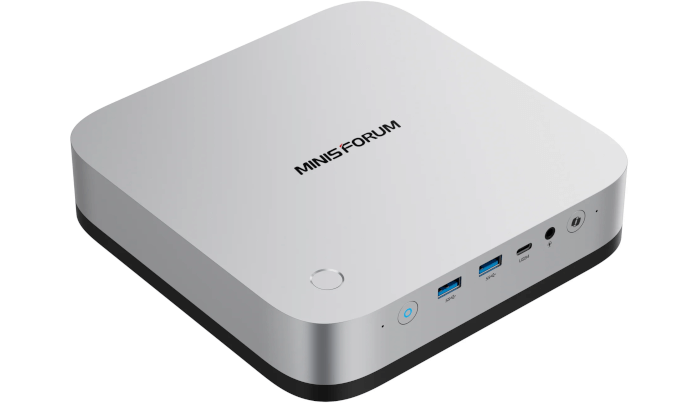
First Impressions running Linux
The machine comes with Windows 11 Pro installed. I did have a quick rummage with Windows in part to see how long it takes for the updates to complete. They take some time. I can probably install a dozen Linux distributions in the time it takes for Windows just to update itself!
The machine has Secure Boot enabled in the BIOS which stops installing a Linux distribution on the machine. First step then is to turn off Secure Boot. Press the Del key at boot up takes you into an colourful graphical BIOS. Select Setup and then Security. Change the Secure Boot dropdown from Enabled to Disabled. Job done. The BIOS has quite a few interesting options which I’ll explore in a later article in this series
I use a USB key to install Linux distributions made with the wonderfully useful open source Ventoy software. That way I have 30+ popular Linux distributions at my fingertips all on a single USB key.
I first installed Kubuntu 25.04 on the machine. I’ve really warmed to KDE Plasma over the past year supplanting GNOME as my default desktop. Installing the distribution takes a fraction of the time it takes Windows to complete its updates.
All the hardware works out of the box including WiFi, displays (at the right resolution and maximum refresh rate), the card reader etc with the exception of Bluetooth. Despite trying a variety of techniques to coax Bluetooth working, nothing played ball. When I run into any type of hardware issue, it’s sometimes quicker just to try another distribution, if only because it can make troubleshooting easier. An Arch-based distro (such as Manjaro) is a good option.
Manjaro installed the Linux kernel version 6.6.101-1. Again, Bluetooth wouldn’t work. Manjaro makes it easy to try different kernels using its Manjaro Settings Manager.
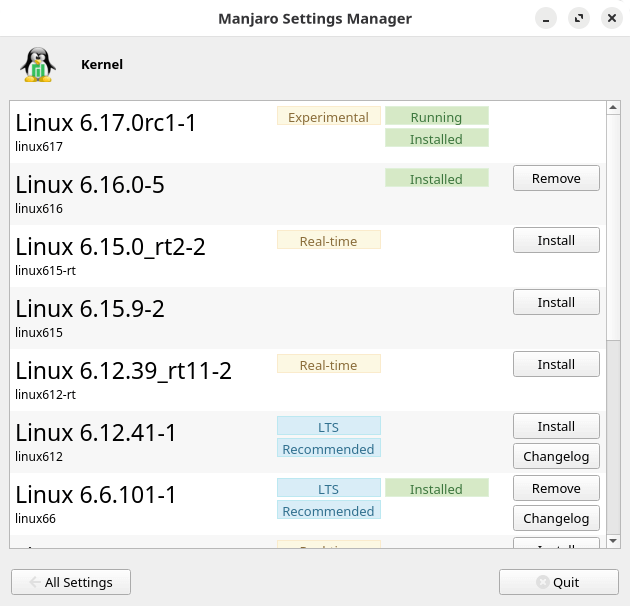
I tried Linux 6.16.0-5, but again no joy. Given the machine has Bluetooth 5.4, I suspected trying an even newer kernel might help. And it did. As soon as I installed Linux 6.17.0rc1-1, Bluetooth works beautifully without any tweaking needed. Maybe I can coax Bluetooth to work with an LTS kernel, but that’s for another day.
Let’s delve into the Minisforum AI X1 Pro’s hardware in more detail.
Next page: Page 3 – Interrogation of the System
Pages in this article:
Page 1 – Introduction and Design
Page 2 – First Impressions running Linux
Page 3 – Interrogation of the System
Complete list of articles in this series:
| Minisforum AI X1 Pro | |
|---|---|
| Introduction | Introduction to the series and interrogation of the machine |
| Benchmarks | Benchmarking the Minisforum AI X1 Pro |
| Power | Testing and comparing the power consumption |
| Jan | ChatGPT without privacy concerns |
| ComfyUI | Generate video, images, 3D, audio with AI |
| AMD Ryzen AI 9 HX 370 Cores | Primary (Zen 5) and Secondary Cores (Zen 5c) |
| Gerbil | Run large language models locally |
| Neural Processing Unit (NPU) | Introduction |
| Gaia | Run LLM Agents |
| Noise | Comparing the machine's noise with other mini PCs |
| Bluetooth | Fixing Bluetooth when dual-booting |
| BIOS | A tour of the Basic Input/Output System |
Do you use this with multiple monitors? Under Ubuntu, I see system crashes, especially when one monitor goes into sleep mode, or when dragging window between screens. It’s unusable. I have the 96GB version.
I am using the X1 Pro with 2 desktop monitors (sometimes with three monitors).
I’ve not experienced a single system crash but I’ve mostly been using Manjaro on this machine, while only sometimes booting into Ubuntu 25.04 and now Ubuntu 25.10
It’s hard to know what’s causing the issue you are experiencing without some detail. I assume you are using GNOME. If you’re using fractional scaling, GNOME is prone to crashing. Maybe try a different desktop environment (such as KDE Plasma) if you need fractional scaling?
Steve, what desktop are you running on the X1 Pro?
KDE Plasma version 6.3.6
Thanks for the tip! I’ve upgraded to Ubuntu from 24.04 to 25.10 (using gnome) and it’s been stable for 24 hours – I need fractional scaling as one monitor is inverted.
That’s good to hear. Maybe the upgrade to GNOME 49 (which comes with Ubuntu 25.10) has better support for fractional scaling). GNOME 49 also dropped X11/Xorg for some distros.