

inori is a terminal client for Music Player Daemon (MPD).
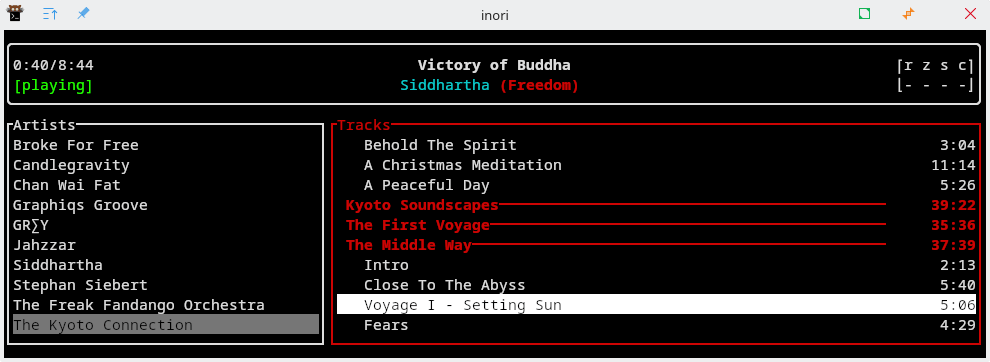
It provides a text user interface focused on efficient music library browsing and playback control, with a folding library view inspired by cmus, a dedicated queue interface, and fast fuzzy searching across tracks, albums, and artists. The project is designed for keyboard-driven use and offers configurable, chainable key bindings along with detailed configuration options.
This is free and open source software.
Key Features
- Provides a terminal user interface for controlling MPD playback and browsing the music library.
- Offers fuzzy search across tracks, albums, and artists using nucleo.
- Includes a folding library interface inspired by cmus.
- Supplies a queue viewer with queue manipulation capabilities.
- Supports configurable, chainable key bindings.
- Includes documented configuration options and a full list of default key bindings.
Website: github.com/eshrh/inori
Support:
Developer: Eshan Ramesh
License: GNU General Public License v3.0
inori is written in Rust. Learn Rust with our recommended free books and free tutorials.
Related Software
| Console MPD Clients | |
|---|---|
| ncmpcpp | Featureful and rock solid ncurses based MPD C++ client inspired by ncmpc |
| ncmpc | Curses based client written in C++ |
| vimpc | vi/vim inspired client for MPD written in C++ |
| PMS | Vim-like console client |
| Zarumet | Polished text user interface |
| pimpd2 | Perl-based client |
| ncmpy | Curses based client written in Python language |
| mmtc | Very minimalistic client written in Rust |
| mpq | Minimalist viewer and manipulator for MPD written in Go |
| inori | Rust-based client |
Read our verdict in the software roundup.
 Explore our comprehensive directory of recommended free and open source software. Our carefully curated collection spans every major software category. Explore our comprehensive directory of recommended free and open source software. Our carefully curated collection spans every major software category.This directory is part of our ongoing series of informative articles for Linux enthusiasts. It features hundreds of detailed reviews, along with open source alternatives to proprietary solutions from major corporations such as Google, Microsoft, Apple, Adobe, IBM, Cisco, Oracle, and Autodesk. You’ll also find interesting projects to try, hardware coverage, free programming books and tutorials, and much more. Discovered a useful open source Linux program that we haven’t covered yet? Let us know by completing this form. |