

An application server is computer software which provides the business logic for an application program. It offers services such as management of large distributed systems, data services, load balancing, transaction support, and network security. The application server is one part of a three-tier application, consisting of a graphical interface server, an application (business logic) server, and a database / transaction server.
There are good reasons to deploy an application server in a corporate environment. At a high level, an application server enables updates and upgrades to applications to be distributed to all users. System administrators also benefit from the fact that changes to application configuration can take place centrally, which greatly simplifies technical support and ultimately the end user experience. Application servers also simplify user management, avoiding the need to set up and maintain user-management systems for applications. This type of software also enhances scalability and resource usage, and exposes business components via different deployment wrappers.
Ruby is a general purpose, scripting, structured, flexible, fully object-oriented programming language with a focus on simplicity and productivity. Ruby is a very conservative language. It’s equipped with very carefully chosen features that have been fully tested.
Here’s our recommended Ruby application servers, captured by a legendary LinuxLinks chart.
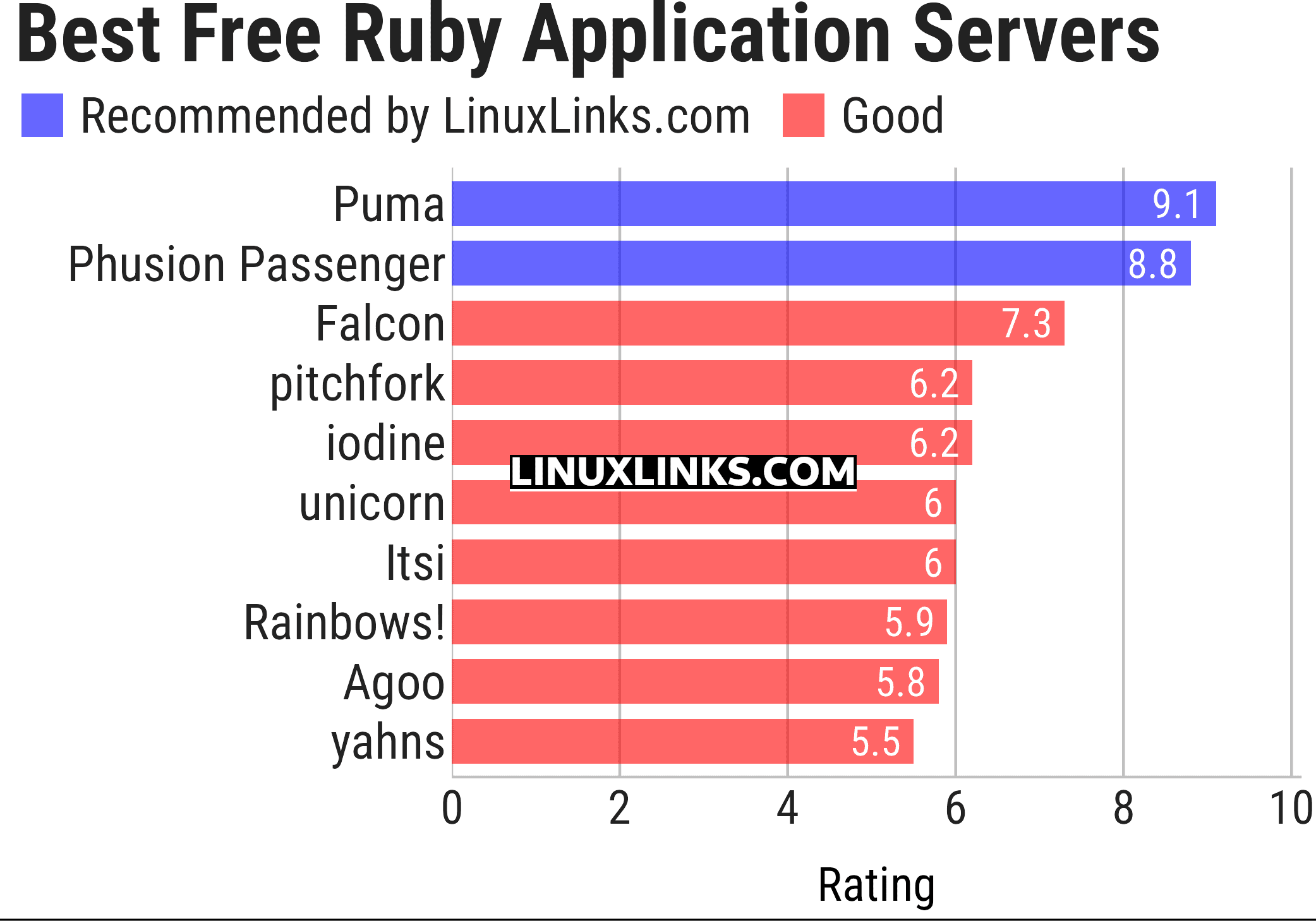
Let’s explore the 10 Ruby application servers. For each program we have compiled its own portal page, a full description with an in-depth analysis of its features, together with links to relevant resources.
| Ruby Application Servers | |
|---|---|
| Puma | Concurrent web server for Ruby and Rack |
| Phusion Passenger | Web server and application server for Ruby, Python and Node.js |
| Falcon | Asynchronous Rack-compatible engine for fast, scalable web traffic |
| pitchfork | Preforking HTTP engine designed for resilience and steady throughput |
| iodine | Lightweight HTTP and WebSocket service built for demanding loads |
| unicorn | HTTP server for Rack applications |
| Itsi | High-performance web serving with efficient request handling |
| Rainbows! | HTTP server for sleepy Rack applications based on Unicorn |
| Agoo | Fast HTTP platform with WebSocket support and very low overhead |
| yahns | Sleepy, multi-threaded, non-blocking application server for Ruby |
This article has been updated to reflect the changes outlined in our recent announcement.
 Explore our comprehensive directory of recommended free and open source software. Our carefully curated collection spans every major software category. Explore our comprehensive directory of recommended free and open source software. Our carefully curated collection spans every major software category.This directory is part of our ongoing series of informative articles for Linux enthusiasts. It features hundreds of detailed reviews, along with open source alternatives to proprietary solutions from major corporations such as Google, Microsoft, Apple, Adobe, IBM, Cisco, Oracle, and Autodesk. You’ll also find interesting projects to try, hardware coverage, free programming books and tutorials, and much more. Know a useful open source Linux program that we haven’t covered yet? Let us know by completing this form. |
Please read our Comment Policy before commenting.