

Matrix is an open standard for interoperable, decentralised, real-time communication over IP.
It can be used to power Instant Messaging, VoIP/WebRTC signalling, Internet of Things communication – or anywhere you need a standard HTTP API for publishing and subscribing to data whilst tracking the conversation history.
The standard can integrate with standard web services via WebRTC, facilitating browser-to-browser applications.
Matrix provides:
- Open Standard HTTP APIs for transferring JSON messages (e.g. instant messages, WebRTC signalling), including:
- Client<->Server API – defines how Matrix compatible clients communicate with Matrix home servers.
- Server<->Server API – defines how Matrix home servers exchange messages and synchronise history with each other.
- Application Service API – defines how to extend the functionality of Matrix with ‘integrations’ and bridge to other networks.
- Modules – specifies features that must be implemented by particular classes of clients.
- Lots of 3rd party contributions of clients, SDKs, servers and services.
This roundup features the finest terminal-based Matrix clients. Only free and open source software is eligible for inclusion. GUI Matrix clients are explored in this roundup.
Here’s our verdict captured in a legendary LinuxLinks-style ratings chart.
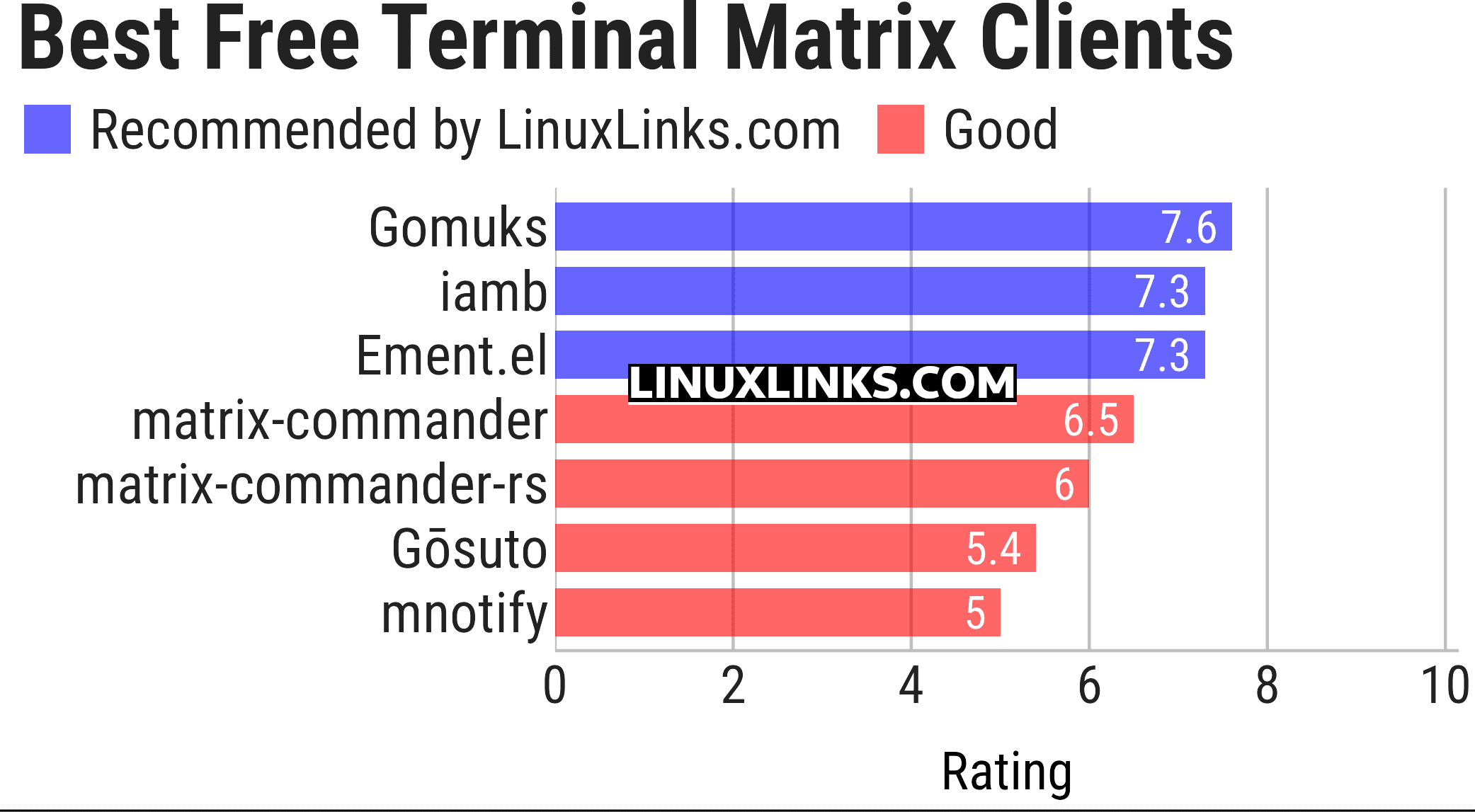
Click the links in the table below to learn all about each client.
| Terminal-Based Matrix Clients | |
|---|---|
| Gomuks | Terminal Matrix client written in Go |
| iamb | Matrix client for Vim addicts |
| Ement.el | Matrix client for Emacs |
| matrix-commander | Simple but convenient CLI-based Matrix client |
| matrix-commander-rs | Command-line Matrix client written in Rust |
| Gōsuto | Lightweight terminal client for the Matrix communication protocol |
| mnotify | Send notifications from a headless server |
This article has been updated to reflect the changes outlined in our recent announcement.
 Explore our carefully curated directory of recommended free and open source software, covering every major software category. Explore our carefully curated directory of recommended free and open source software, covering every major software category.The directory forms part of our extensive collection of articles for Linux enthusiasts. It includes hundreds of detailed reviews, together with free and open source alternatives to proprietary software from companies such as Google, Microsoft, Apple, Adobe, IBM, Cisco, Oracle, and Autodesk. LinuxLinks also covers interesting projects worth exploring, Linux-compatible hardware, free programming books and tutorials, and much more. Know a useful free and open source Linux application that we haven’t covered? Tell us about it using our submission form. |
Please read our Comment Policy before commenting.