

A screen-reader is a computer application designed to provide spoken feedback to a blind or visually impaired person. This type of software has been available since the mid 1980s.
The software transmits what text is displayed on the screen into a form that a visually impaired user can understand. This can be auditory, tactile, or both. A lot of research and development was undertaken to provide speech-access to the Graphical User Interface.
Screen-readers read the contents of a visual display. They can use a speech synthesizer to read text aloud letting users listen to the contents appearing in different parts of the display. Other software communicates data via a braille display.
Screen-readers help make the world of computers accessible to visually impaired users.
Here’s our verdict summarized in a legendary LinuxLinks-style chart. The software featured here is free and open source software. Note, Emacspeak takes a different approach. While it’s not technically a screen-reader, it warrants inclusion.
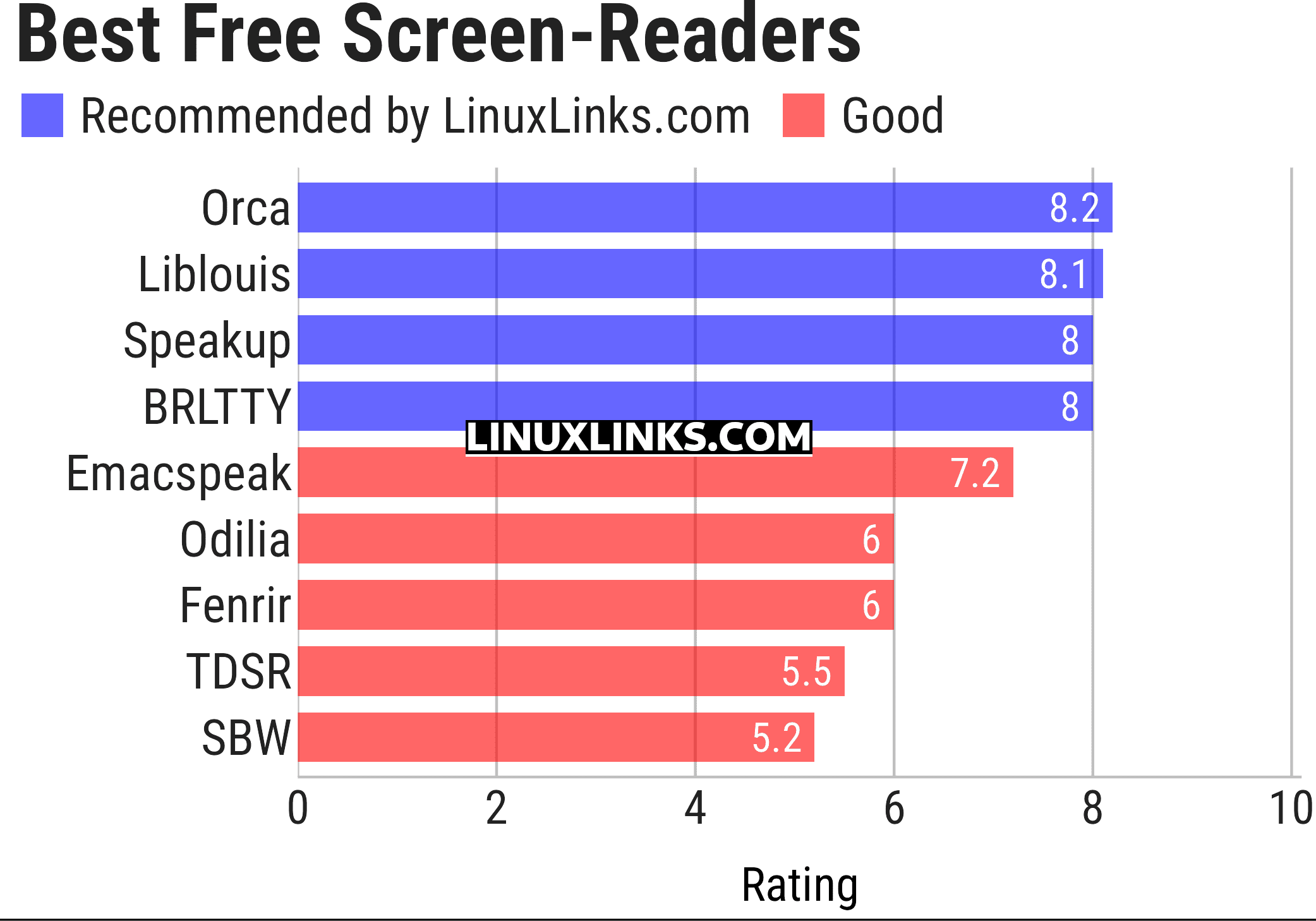
Let’s explore each application in more detail. For each program we have compiled its own portal page, a full description with an in-depth analysis of its features, together with links to relevant resources.
| Screen-readers | |
|---|---|
| Orca Screen Reader | Screen-reader which provides access to applications and toolkits |
| Liblouis | Braille translator, back-translator and formatter |
| Speakup | Kernel-based speech synthesizer driver suite |
| BRLTTY | Provides access to the console using a refreshable braille display |
| Emacspeak | Emacs extension that provides spoken output |
| Odilia | Rust-based screen reader |
| Fenrir | Fast, flexible and efficient speech access for Linux text consoles |
| TDSR | Lightweight speech access for navigating Linux virtual consoles |
| SBW | Text editor with support for braille input |
This article has been updated to reflect the changes outlined in our recent announcement.
 Explore our carefully curated directory of recommended free and open source software, covering every major software category. Explore our carefully curated directory of recommended free and open source software, covering every major software category.The directory forms part of our extensive collection of articles for Linux enthusiasts. It includes hundreds of detailed reviews, together with free and open source alternatives to proprietary software from companies such as Google, Microsoft, Apple, Adobe, IBM, Cisco, Oracle, and Autodesk. LinuxLinks also covers interesting projects worth exploring, Linux-compatible hardware, free programming books and tutorials, and much more. Know a useful free and open source Linux application that we haven’t covered? Tell us about it using our submission form. |
Please read our Comment Policy before commenting.