
Object–relational mapping (ORM) is a programming technique for converting data between incompatible type systems using object-oriented programming languages. This creates, in effect, a “virtual object database” that can be used from within the programming language.
In essence, ORM is a design pattern for converting (wrapping) that data stored within a relational database into an object that can be used within an object oriented language. It creates a layer between the language and the database, helping programmers work with data without the OOP paradigm.
Compared to traditional techniques of exchange between an object-oriented language and a relational database, ORM often reduces the amount of code that needs to be written. It standardizes interfaces reducing boilerplate and speeding development time. Advocates of ORMs claim they increase productivity, improve application design, reuse code and maintain the application over time. On the other hand, ORM suffers the disadvantage of the abstraction obscuring what’s happening in the code. And over-use of ORM software can produce poorly designed databases.
There is a good range of Python-based ORM software available. Here’s our verdict summarized in a legendary LinuxLinks-style ratings chart. Only free and open source software is eligible for inclusion.
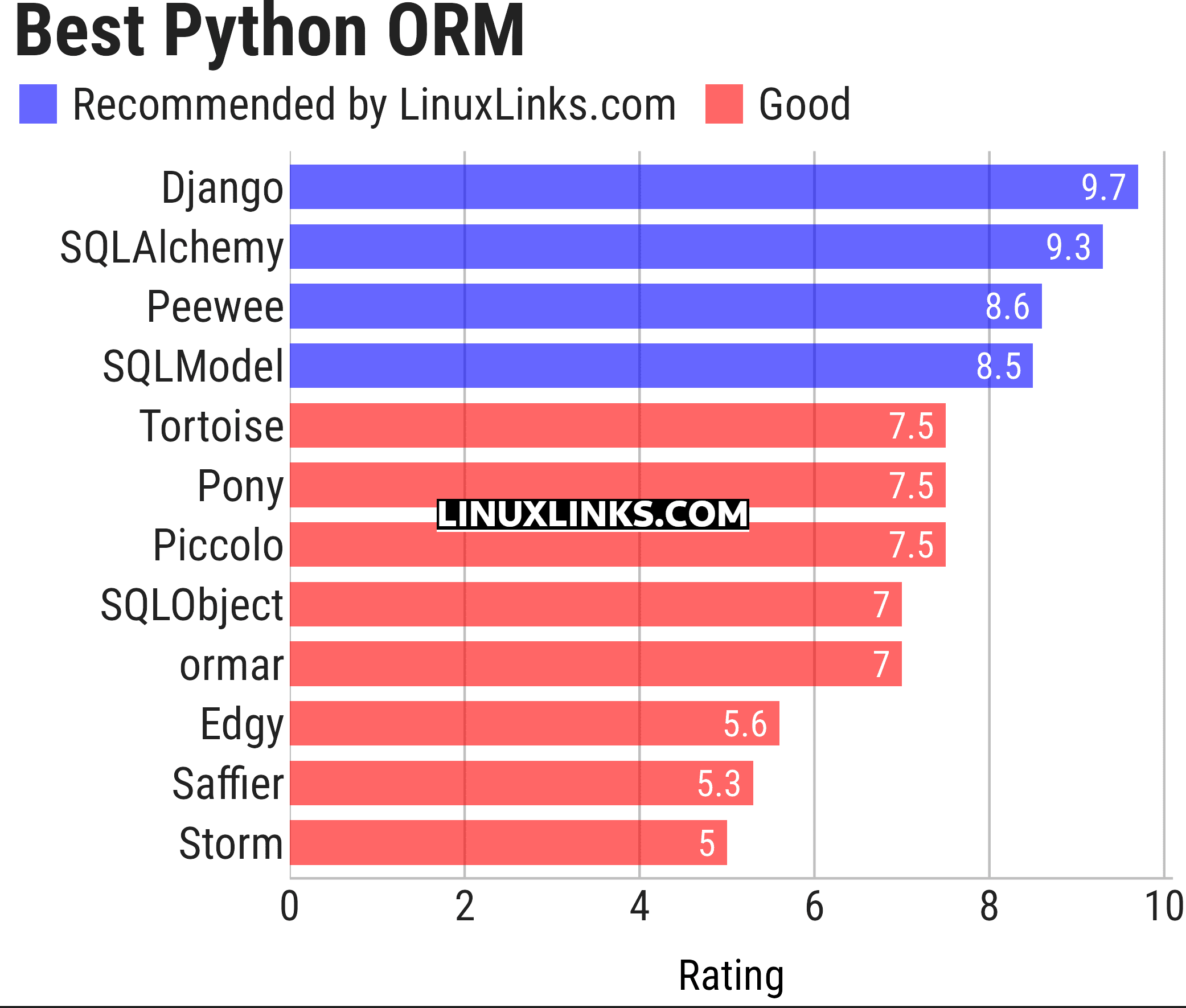
Let’s explore the 12 ORM tools for Python. For each program we have compiled its own portal page, a full description with an in-depth analysis of its features, together with links to relevant resources.
| Python Object-Relational Mapping Software | |
|---|---|
| Django | High-level web application framework that has a powerful ORM |
| SQLAlchemy | Python SQL Toolkit and Object Relational Mapper |
| Peewee | Simple, small and expressive Object Relational Mapper. It has few concepts |
| SQLModel | Combines database models with type-safe data validation |
| Tortoise | Easy-to-use asyncio ORM inspired by Django |
| Pony | Billed as the smartest Python ORM |
| Piccolo | Async-first database toolkit with migrations and a powerful query API |
| SQLObject | Forms a part of many applications including TurboGears |
| ormar | Build expressive async database models with minimal boilerplate |
| Edgy | Modern async database layer focused on simplicity and flexibility |
| Saffier | Lightweight async data modelling with support for multiple databases |
| Storm | Designed to work with thin relational databases and big systems |
This article has been updated to reflect the changes outlined in our recent announcement.
 Explore our comprehensive directory of recommended free and open source software. Our carefully curated collection spans every major software category. Explore our comprehensive directory of recommended free and open source software. Our carefully curated collection spans every major software category.This directory is part of our ongoing series of informative articles for Linux enthusiasts. It features hundreds of detailed reviews, along with open source alternatives to proprietary solutions from major corporations such as Google, Microsoft, Apple, Adobe, IBM, Cisco, Oracle, and Autodesk. You’ll also find interesting projects to try, hardware coverage, free programming books and tutorials, and much more. Know a useful open source Linux program that we haven’t covered yet? Let us know by completing this form. |
Please read our Comment Policy before commenting.