

SSH or Secure Shell is a cryptographic network protocol for operating network services securely over an unsecured network. Typical applications include remote command-line, login, and remote command execution, but any network service can be secured with SSH.
SSH was designed as a replacement for Telnet and for unsecured remote shell protocols such as the Berkeley rsh and the related rlogin and rexec protocols. Those protocols send information, notably passwords, in plaintext, rendering them susceptible to interception and disclosure using packet analysis. The encryption used by SSH is intended to provide confidentiality and integrity of data over an unsecured network, such as the Internet.
There are many ways to make a server running SSH more secure. Here are some examples: Disable root logins, use private key authentications (rather than ssh passwords), enable two-factor authentication, change the port used by SSH, don’t listen on every interface, limit users’ SSH access, and make sure the operating system is kept up-to-date.
There are more steps you can take to harden the server. This article recommends open source software that employ different techniques to make it harder for a server running SSH to be compromised.
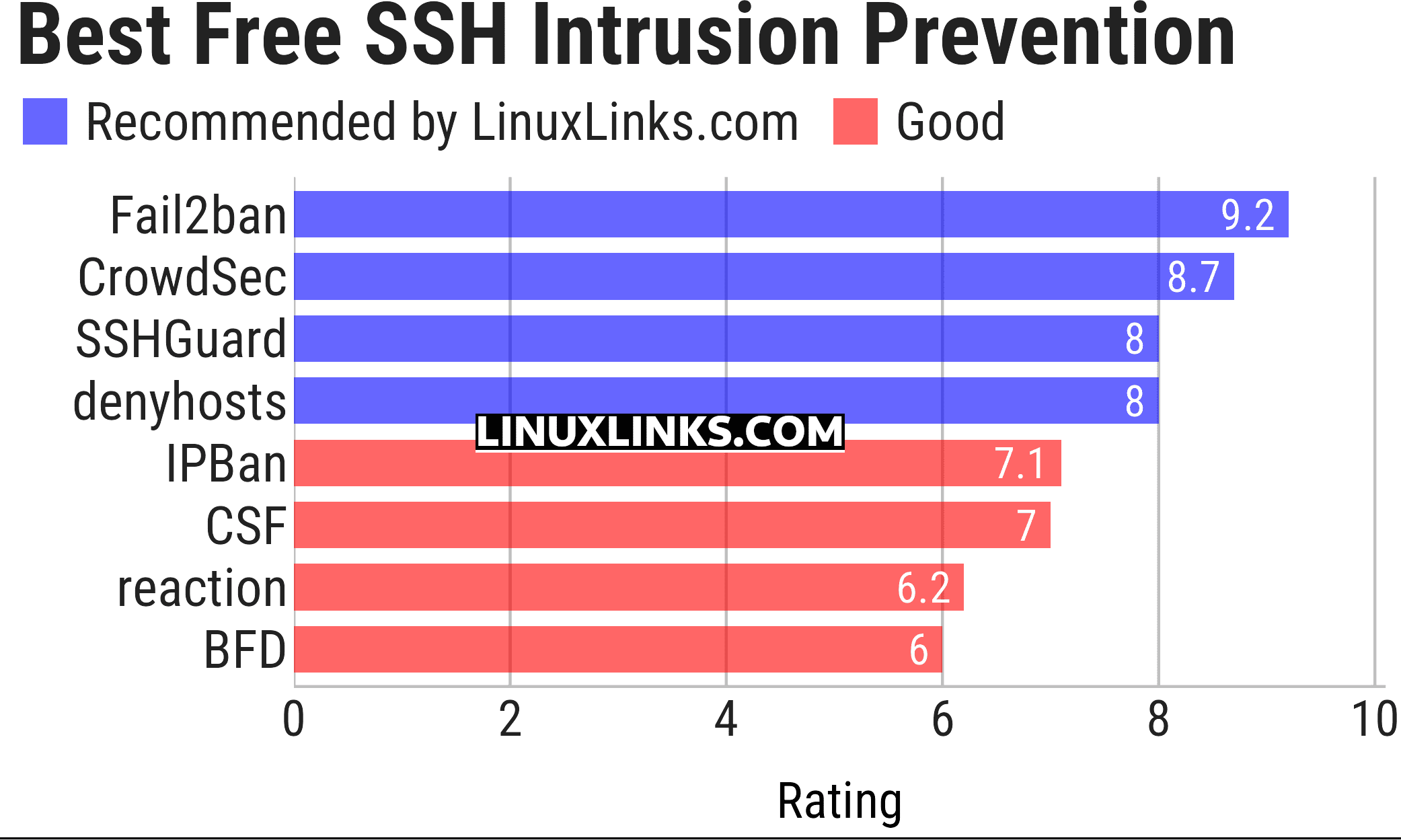
We list our recommendations below captured in a legendary LinuxLinks-style ratings chart. All of the software featured here is published under an open source license.
| Intrusion Prevention for SSH | |
|---|---|
| Fail2Ban | Intrusion prevention software framework written in Python |
| CrowdSec | Modern and collaborative behavior detection engine |
| SSHGuard | Protects hosts from brute-force attacks against SSH and other services |
| denyhosts | Helps thwart SSH server attacks |
| IPBan | Detects repeated failed logins |
| CSF | ConfigServer Security & Firewall |
| reaction | Daemon that scans program outputs for repeated patterns, and takes action |
| BFD | Log-based security tool that detects authentication failures |
This article has been updated to reflect the changes outlined in our recent announcement.
 Explore our carefully curated directory of recommended free and open source software, covering every major software category. Explore our carefully curated directory of recommended free and open source software, covering every major software category.The directory forms part of our extensive collection of articles for Linux enthusiasts. It includes hundreds of detailed reviews, together with free and open source alternatives to proprietary software from companies such as Google, Microsoft, Apple, Adobe, IBM, Cisco, Oracle, and Autodesk. LinuxLinks also covers interesting projects worth exploring, Linux-compatible hardware, free programming books and tutorials, and much more. Know a useful free and open source Linux application that we haven’t covered? Tell us about it using our submission form. |
Please read our Comment Policy before commenting.