

An address book is a database that stores names, addresses and other contact information for a computer user.
Address books allow easy access to the user’s friends, family, business associates and others by maintaining their email and other contact details on their computer.
This article focuses on standalone software. CardOver is tightly integrated with Thunderbird but it can also run independently.
Here’s our verdict captured in a legendary LinuxLinks-style chart. We only feature free and open source software here.
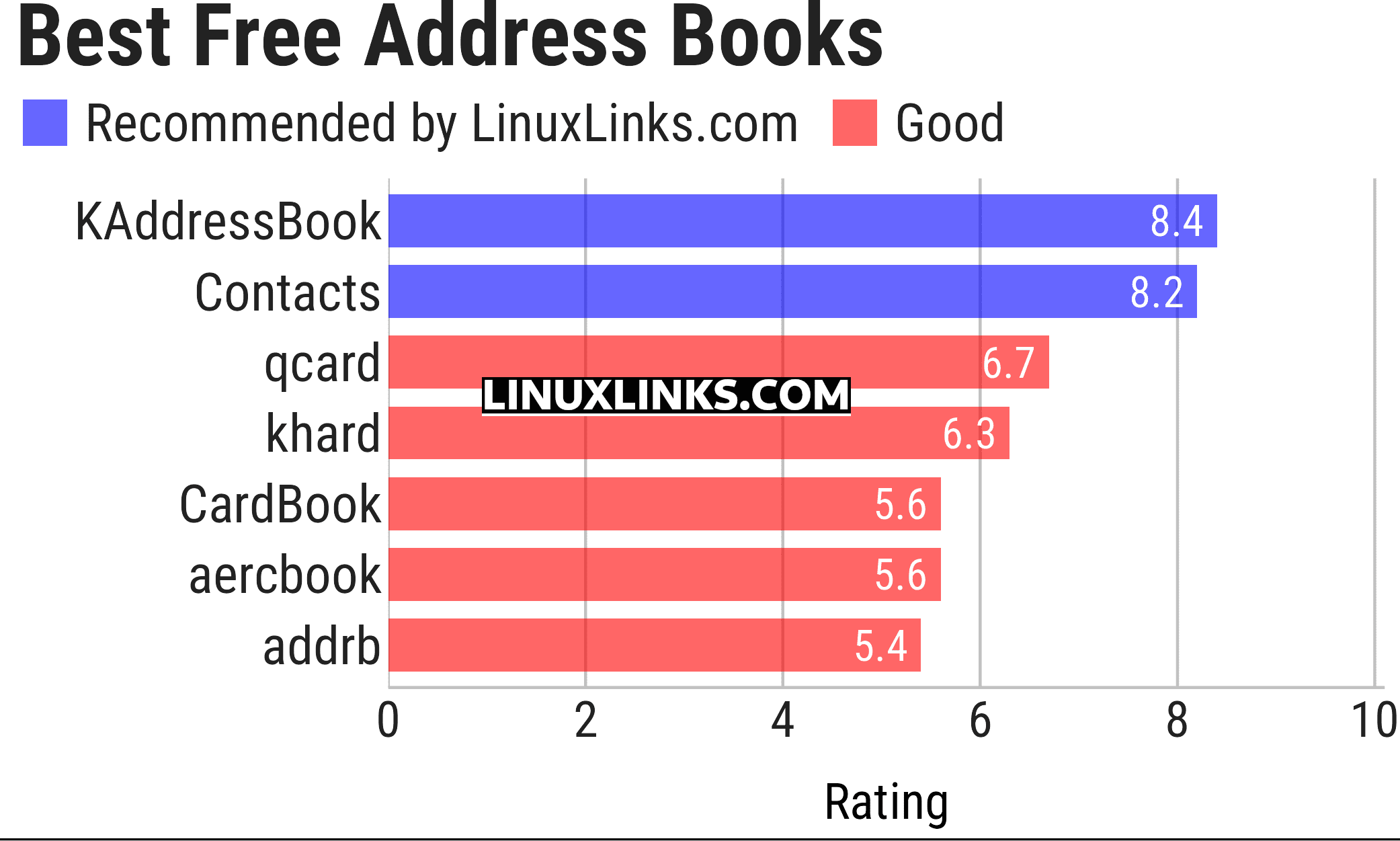
Let’s explore the 7 address book managers. For each program we have compiled its own portal page, a full description with an in-depth analysis of its features, screenshot of the program in action, together with links to relevant resources.
| Address Book Managers | |
|---|---|
| KAddressBook | Supports a wide range of services including NextCloud, Google Contacts |
| Contacts | GNOME's integrated address book. It is written in Vala and uses libfolks |
| qcard | CLI addressbook application for CardDAV servers |
| khard | Console vcard client |
| CardBook | Thunderbird address book based on CardDAV and vCard standards |
| aercbook | Minimalist address book for the aerc e-mail client |
| addrb | Lightweight, read-only command-line address book |
There are many other apps that include an integrated address book such as Evolution.
This article has been updated to reflect the changes outlined in our recent announcement.
 Explore our comprehensive directory of recommended free and open source software. Our carefully curated collection spans every major software category. Explore our comprehensive directory of recommended free and open source software. Our carefully curated collection spans every major software category.This directory is part of our ongoing series of informative articles for Linux enthusiasts. It features hundreds of detailed reviews, along with open source alternatives to proprietary solutions from major corporations such as Google, Microsoft, Apple, Adobe, IBM, Cisco, Oracle, and Autodesk. You’ll also find interesting projects to try, hardware coverage, free programming books and tutorials, and much more. Know a useful open source Linux program that we haven’t covered yet? Let us know by completing this form. |
Please read our Comment Policy before commenting.