
One of the types of software that’s important for a web developer is the web framework. A framework “is a code library that makes a developer’s life easier when building reliable, scalable, and maintainable web applications” by providing reusable code or extensions for common operations. By saving development time, developers can concentrate on application logic rather than mundane elements.
A web framework offers the developer a choice about how to solve a specific problem. By using a framework, a developer lets the framework control portions of their application. While it’s perfectly possible to code a web application without using a framework, it’s more practical to use one.
Julia is a high-level, high-performance dynamic programming language for technical computing. Although Julia is a new language, first appearing in 2012, its roots are in Lisp, so it comes with mature features like macros and support for other metaprogramming techniques like code generation. Julia’s expressive grammar lets you write easy-to-read and easier-to-debug code, and its speed gets you through more work in less time. It’s a great choice whether you’re designing a machine learning system, crunching statistical data, or writing system utilities.
Here’s our verdict captured in a legendary LinuxLinks chart. We only feature open source goodness.
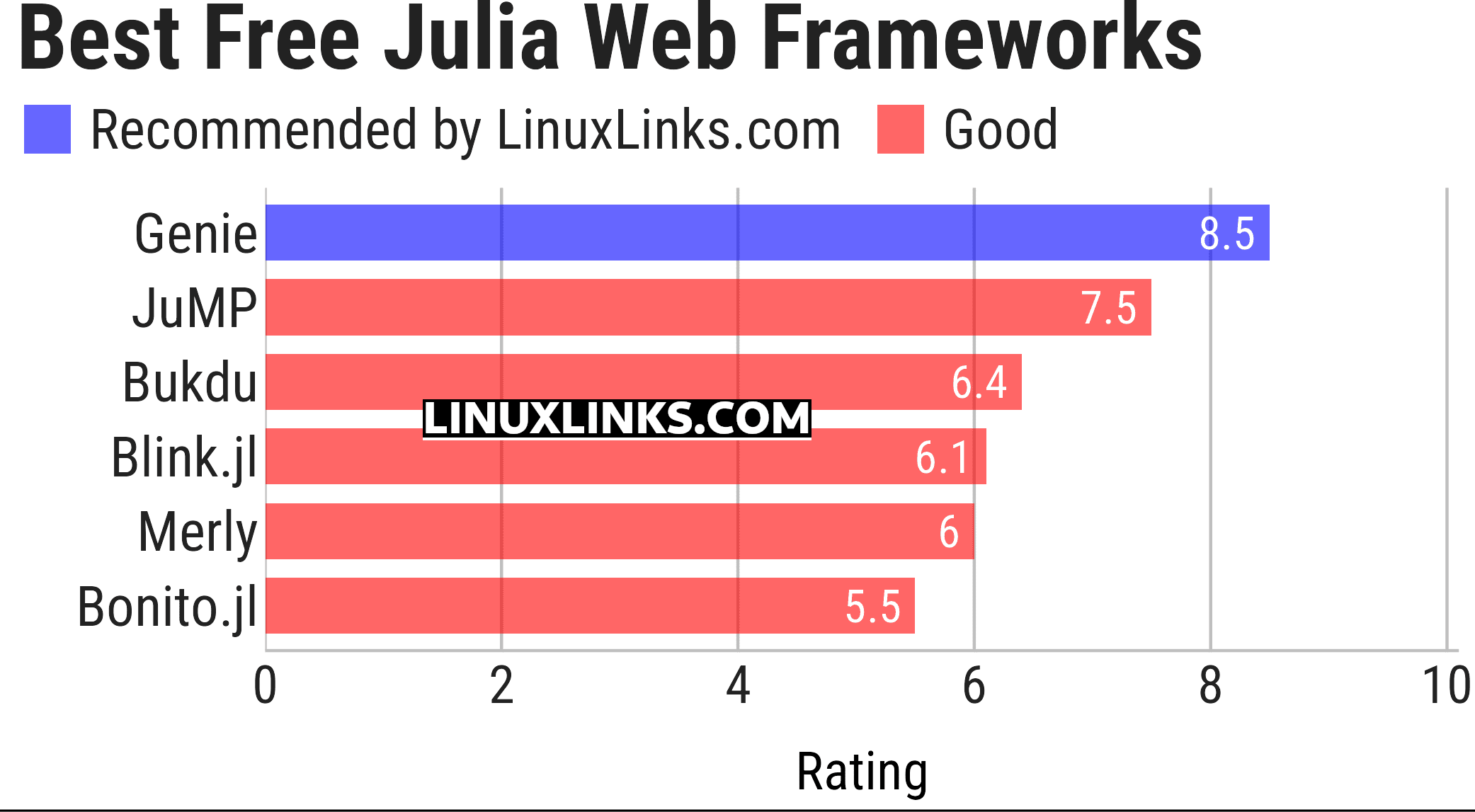
Let’s explore the 6 Julia web frameworks. For each program we have compiled its own portal page, a full description with an in-depth analysis of its features, together with links to relevant resources.
| Julia Web Frameworks | |
|---|---|
| Genie | Complete solution for developing modern full-stack web applications |
| JuMP | Domain-specific modeling language for mathematical optimization |
| Bukdu | Web development framework that seeks inspiration from the Phoenix framework |
| Blink.jl | Julia wrapper around Electron |
| Merly | Microframework for declaring routes and handling requests |
| Bonito.jl | Build interactive web applications, dashboards, and visualizations |
This article has been updated to reflect the changes outlined in our recent announcement.
 Explore our comprehensive directory of recommended free and open source software. Our carefully curated collection spans every major software category. Explore our comprehensive directory of recommended free and open source software. Our carefully curated collection spans every major software category.This directory is part of our ongoing series of informative articles for Linux enthusiasts. It features hundreds of detailed reviews, along with open source alternatives to proprietary solutions from major corporations such as Google, Microsoft, Apple, Adobe, IBM, Cisco, Oracle, and Autodesk. You’ll also find interesting projects to try, hardware coverage, free programming books and tutorials, and much more. Know a useful open source Linux program that we haven’t covered yet? Let us know by completing this form. |
Please read our Comment Policy before commenting.