

fdf is a high performance command line file finder written in Rust.
It’s designed as a lightweight alternative to tools such as fd and find, with an emphasis on fast directory traversal, regex and glob based searching, and POSIX platform support. The project uses low level filesystem optimisations, parallel traversal, and direct system interfaces where available.
This is free and open source software.
Key Features
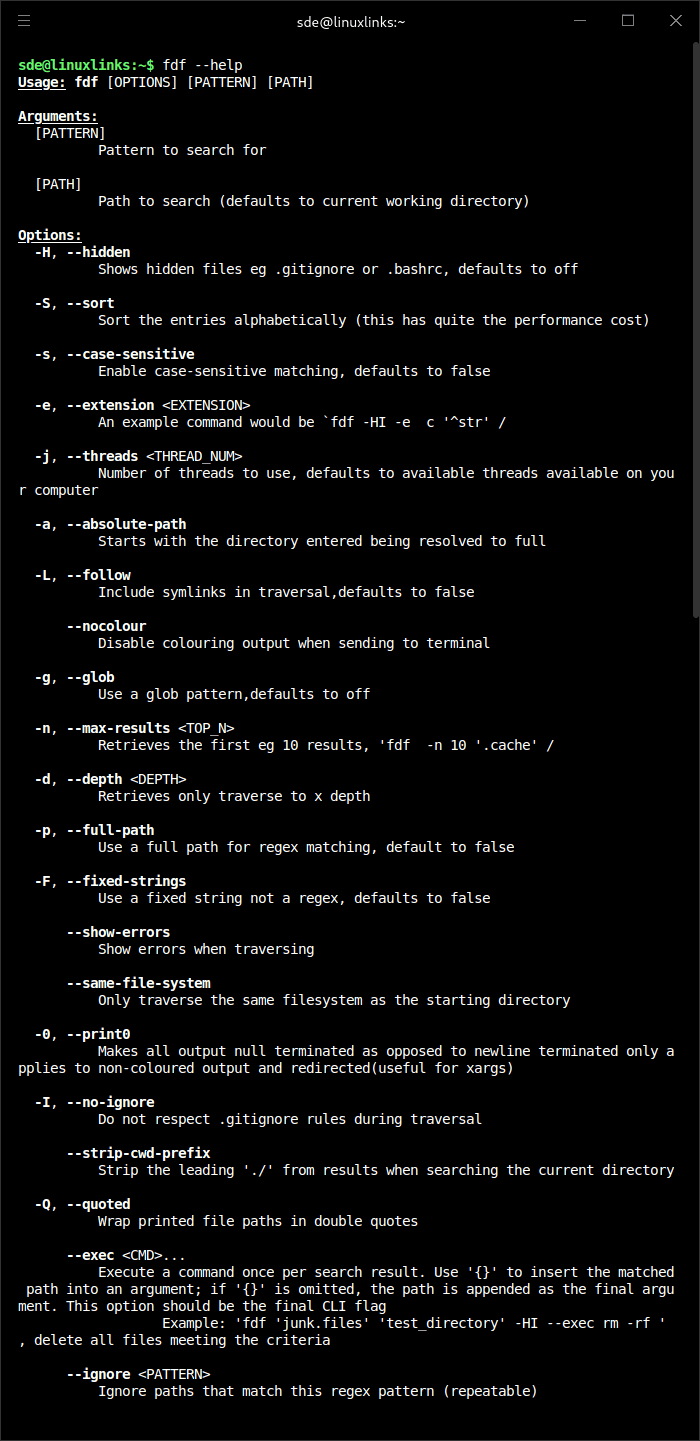
- Searches files and directories using regular expressions, glob patterns, or fixed strings.
- Supports filters for extensions, file type, file size, modification time, depth, and full path matching.
- Includes multi-threaded traversal with configurable thread count.
- Can respect or ignore .gitignore rules during searches.
- Offers options for hidden files, symlink following, filesystem boundaries, and sorted output.
- Provides null terminated output for use with tools such as xargs.
- Can execute a command once per search result using the exec option.
- Generates shell completions for bash, zsh, fish, PowerShell, and elvish.
- Cross-platform support – runs under Linux, macOS, FreeBSD, NetBSD, OpenBSD, Solaris, Illumos, Android, and 32-bit Linux to varying levels.
Website: github.com/alexcu2718/fdf
Support:
Developer: Alex Curtis
License: MIT License
fdf is written in Rust. Learn Rust with our recommended free books and free tutorials.
Related Software
| Alternatives to find | |
|---|---|
| fd | Simple, fast and user-friendly alternative to 'find' |
| fzf | General-purpose command-line fuzzy finder |
| bfind | Minimalistic find using breadth-first crawling |
| ffind | Sane replacement for command line file search |
| friendly-find | Friendly file finder |
| bfs | Breadth-first search for your files |
| fselect | Find files with SQL-like queries |
| treegrep | Pattern matcher frontend or backend |
| findpick | General purpose file picker combining “find” command with a fuzzy finder |
| rawhide | Find files using pretty C expressions |
| scooter | Interactive find-and-replace terminal UI app |
 Explore our comprehensive directory of recommended free and open source software. Our carefully curated collection spans every major software category. Explore our comprehensive directory of recommended free and open source software. Our carefully curated collection spans every major software category.This directory is part of our ongoing series of informative articles for Linux enthusiasts. It features hundreds of detailed reviews, along with open source alternatives to proprietary solutions from major corporations such as Google, Microsoft, Apple, Adobe, IBM, Cisco, Oracle, and Autodesk. You’ll also find interesting projects to try, hardware coverage, free programming books and tutorials, and much more. Discovered a useful open source Linux program that we haven’t covered yet? Let us know by completing this form. |
Please read our Comment Policy before commenting.