

Last Updated on January 5, 2026
Kubernetes (also known as K8s) is a powerful open-source platform designed to streamline the deployment, scaling, and management of containerized applications.
Think of it as the “operating system for the cloud,” expertly orchestrating containers — such as those from Docker — across clusters of machines. It simplifies the management of complex microservices, ensures that applications are always available, efficiently manages resource allocation, and creates consistent environments from development to production. This makes Kubernetes the go-to solution for running applications at scale in the industry.
Kubernetes offers a variety of powerful features that enhance your container management experience:
- Service Discovery and Load Balancing: Kubernetes can expose containers via DNS names or their own IP addresses. When traffic to a container increases, it can efficiently distribute that network traffic, ensuring stability for your deployment.
- Storage Orchestration: With Kubernetes, you can automatically mount your preferred storage solutions, whether they’re local systems or cloud-based options.
- Automated Rollouts and Rollbacks: By defining the desired state for your containers, Kubernetes manages the transition from the current state to the desired state at a controlled pace. It simplifies the process of creating new containers, removing old ones, and reallocating resources.
- Automatic Bin Packing: You provide a cluster of nodes for Kubernetes to utilize for running containerized tasks. You specify the CPU and RAM requirements for each container, and Kubernetes optimizes resource usage by fitting containers onto the nodes effectively.
- Self-Healing: Kubernetes monitors container health, automatically restarting or replacing any containers that fail. It will not advertise containers until they are fully operational and ready to serve requests.
- Secret and Configuration Management: Kubernetes facilitates the secure storage and management of sensitive data such as passwords, OAuth tokens, and SSH keys. You can deploy and update these secrets and configurations without the need to rebuild container images, keeping them secure and out of your stack configuration.
- Batch Execution: In addition to managing services, Kubernetes can handle your batch and continuous integration workloads, with options for replacing any failing containers as needed.
- Horizontal Scaling: You can easily scale your applications up or down with a simple command, through the user interface, or automatically based on CPU usage patterns.
- IPv4/IPv6 Dual-Stack: Kubernetes supports the allocation of both IPv4 and IPv6 addresses for your Pods and Services, ensuring compatibility in diverse networking environments.
- Designed for Extensibility: You can enhance your Kubernetes cluster with additional features without modifying the upstream source code.
This roundup selects our pick of tools that make you more productive using Kubernetes. Here’s our verdict captured in a legendary LinuxLinks-style ratings chart. Only free and open source software is eligible for inclusion.
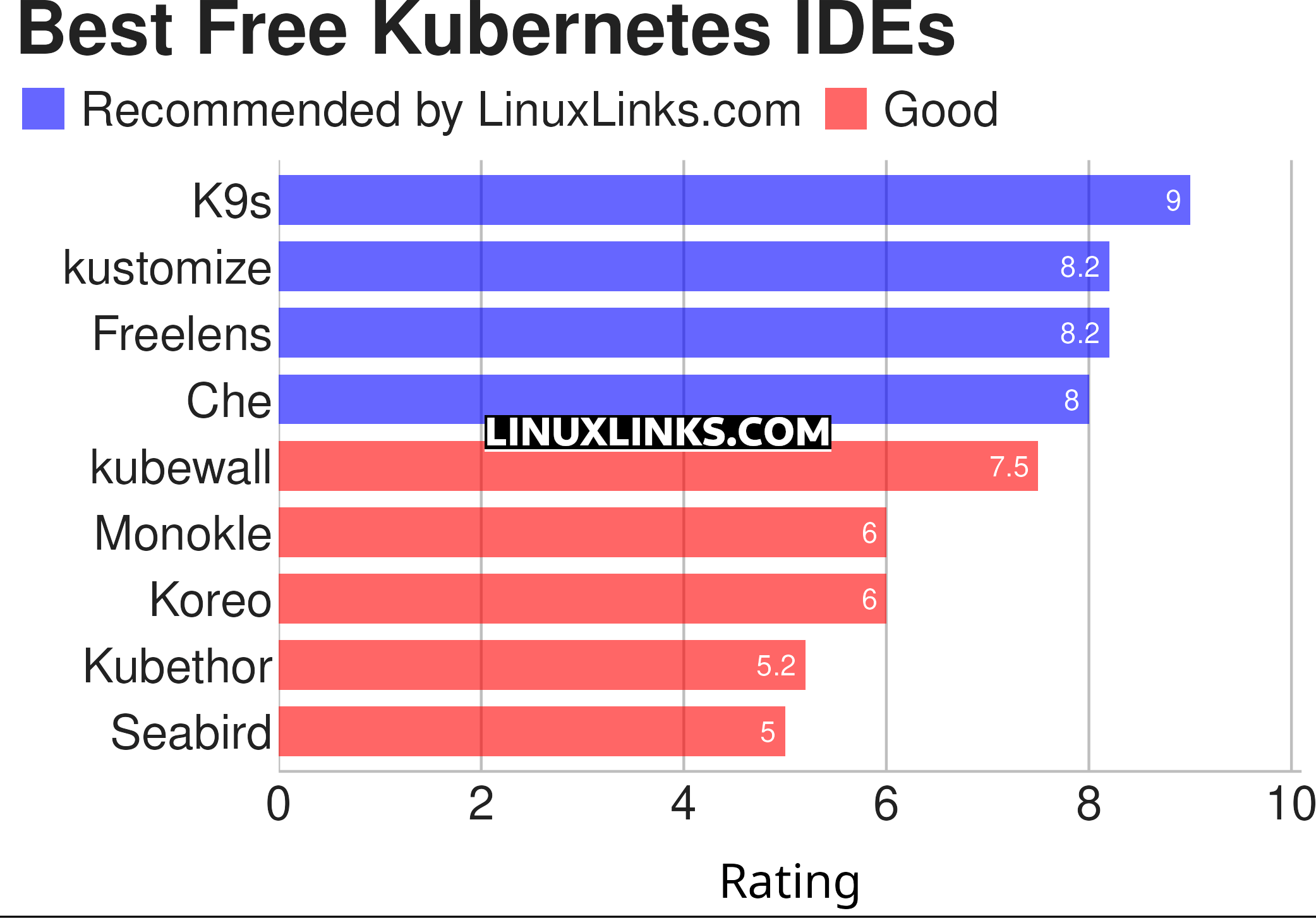
Click the links below to learn more about each IDE.
| IDEs for Kubernetes | |
|---|---|
| K9s | Kubernetes CLI To Manage Your Clusters |
| kustomize | Manage declarative configuration of Kubernetes |
| Freelens | Graphical interface for managing and monitoring Kubernetes clusters |
| Che | Kubernetes based Cloud Development Environments for Enterprise Teams |
| kubewall | Single-binary Kubernetes dashboard |
| Monokle | Create and maintain high-quality Kubernetes configurations |
| Koreo | Platform engineering toolkit for Kubernetes |
| Kubethor | Kubernetes management web application |
| Seabird | Kubernetes IDE designed for the GNOME desktop |
 Explore our comprehensive directory of recommended free and open source software. Our carefully curated collection spans every major software category. Explore our comprehensive directory of recommended free and open source software. Our carefully curated collection spans every major software category.This directory is part of our ongoing series of informative articles for Linux enthusiasts. It features hundreds of detailed reviews, along with open source alternatives to proprietary solutions from major corporations such as Google, Microsoft, Apple, Adobe, IBM, Cisco, Oracle, and Autodesk. You’ll also find interesting projects to try, hardware coverage, free programming books and tutorials, and much more. Know a useful open source Linux program that we haven’t covered yet? Let us know by completing this form. |