

CardDAV (“Card Distributed Authoring and Versioning”) is a standardized address book client/server protocol for managing and sharing contact information over the internet.
This is an extension of the WebDAV (Web Distributed Authoring and Versioning) protocol, which is used for collaborative editing and managing files on remote web servers.
CardDAV focuses on the synchronization and management of address book or contact data.
What does CardDAV offer?
- Synchronize address books or contact lists between different devices and applications. This lets users to maintain a consistent set of contacts across email clients, smartphones, and other devices.
- Platform-independent, making it suitable for use on different operating systems and devices. It’s commonly used with email clients, calendar apps, and contact management software.
- Open and standardized protocol, defined by the Internet Engineering Task Force (IETF). This openness promotes interoperability between different software and services that implement the protocol.
- Used with secure connections (HTTPS) to ensure the privacy and integrity of contact data during transmission. It also supports authentication mechanisms for secure access control.
- Users can add, modify, delete, and organize contact information, such as names, email addresses, phone numbers, and more, in their address books.
- CardDAV servers store contact data, allowing users to access their contacts from anywhere with an internet connection. This is especially useful for users who want to maintain a centralized address book accessible across multiple devices.
There’s a fairly small range of CardDAV servers available for Linux. We’ve summarised our findings in the rating chart below. Only free and open source software is eligible for inclusion.
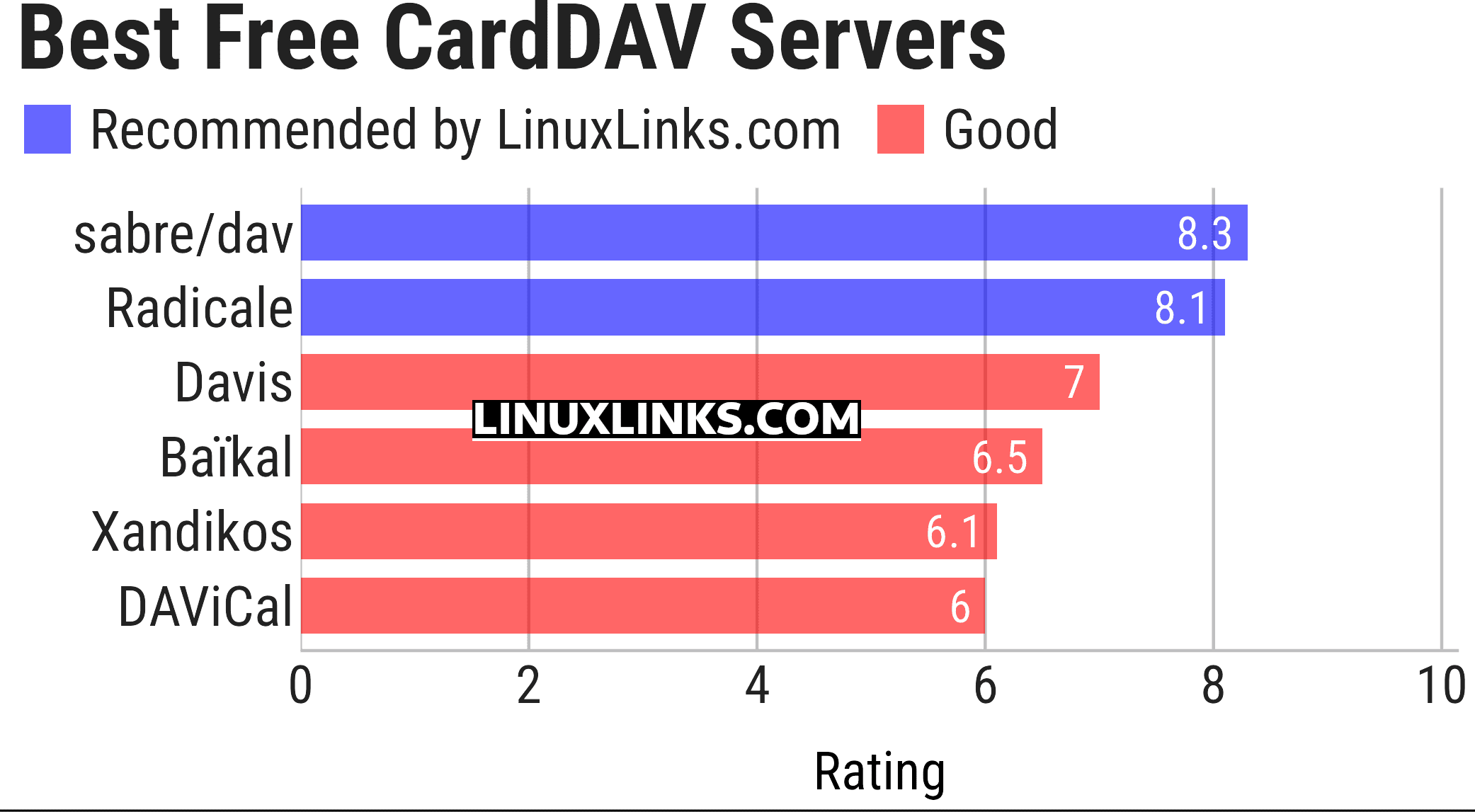
Learn more about the CardDAV servers. Click the links in the table below to learn more about each server.
| CardDAV Servers | |
|---|---|
| sabre/dav | Create WebDAV, CalDAV and CardDAV servers |
| Radicale | Small but powerful CalDAV and CardDAV server |
| Davis | CalDAV, CardDAV and WebDAV server with web administration |
| Baïkal | Extensive web interface managing users, address books and calendars |
| Xandikos | Lightweight and complete CardDAV/CalDAV server |
| DAViCal | CalDAV server for sharing calendars and managing access rights |
This article has been updated to reflect the changes outlined in our recent announcement.
 LinuxLinks helps you discover the best free and open source software for Linux. Explore our extensive collection of recommended applications, including alternatives to popular proprietary software. We also publish software reviews, Linux tutorials, hardware reviews, free programming books and articles covering the wider open source community. Browse our Linux resources to discover more. Know a useful free and open source Linux application we haven't covered? Suggest a program for inclusion. Has your software been featured on LinuxLinks? Display one of our Featured on LinuxLinks badges on your website or GitHub README. |
Please read our Comment Policy before commenting.